 Wow.
Wow.
I’d heard good things about Firedoor, but in November, we had a pretty much perfect food night: surprising, tasty and innovative with an extremely fair price of $85 for a whatever-the-chef-decides kind of night.
 The interiors are Surry Hills chic (and a complete transformation from the cozy café Strawberry Cross that occupied the space beforehand).
The open kitchen was very fun to watch with an international crew of men putting together the dishes.
We felt sorry for the guy at the station in the back with the charcoal and hot pans. I reckon he doesn’t have any fingerprints left.
Service was superb and engaging, helping to get us even more interested in the food that arrived.
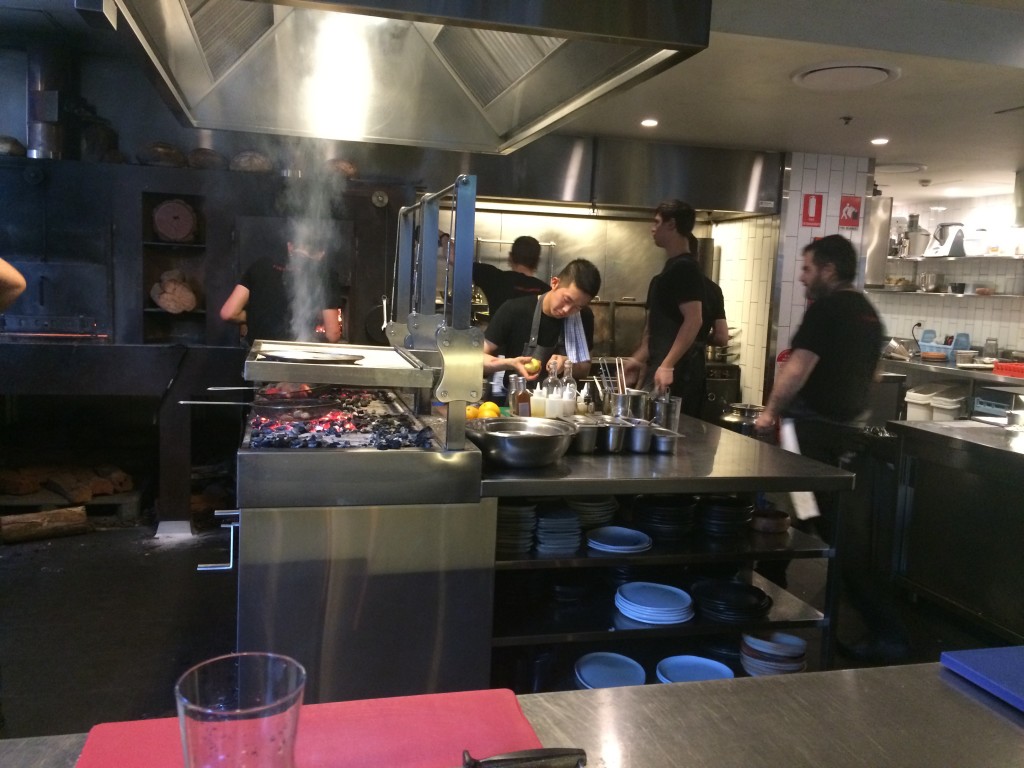 The theme of this restaurant is fire. Nearly everything is cooked on a grill or with a wood-fired oven. They actually make their own charcoal out of different wood and use it as to add flavour to the food! Crazy and unique and yet the essence of the food is not trickery, but primally good food! So, a delicious smoke flavour was added to nearly each dish, from the delicious butter that accompanied the homemade bread to the wonderful ricotta starter and then the awesome grilled beans.
We both loved the fennel and orange with fish…
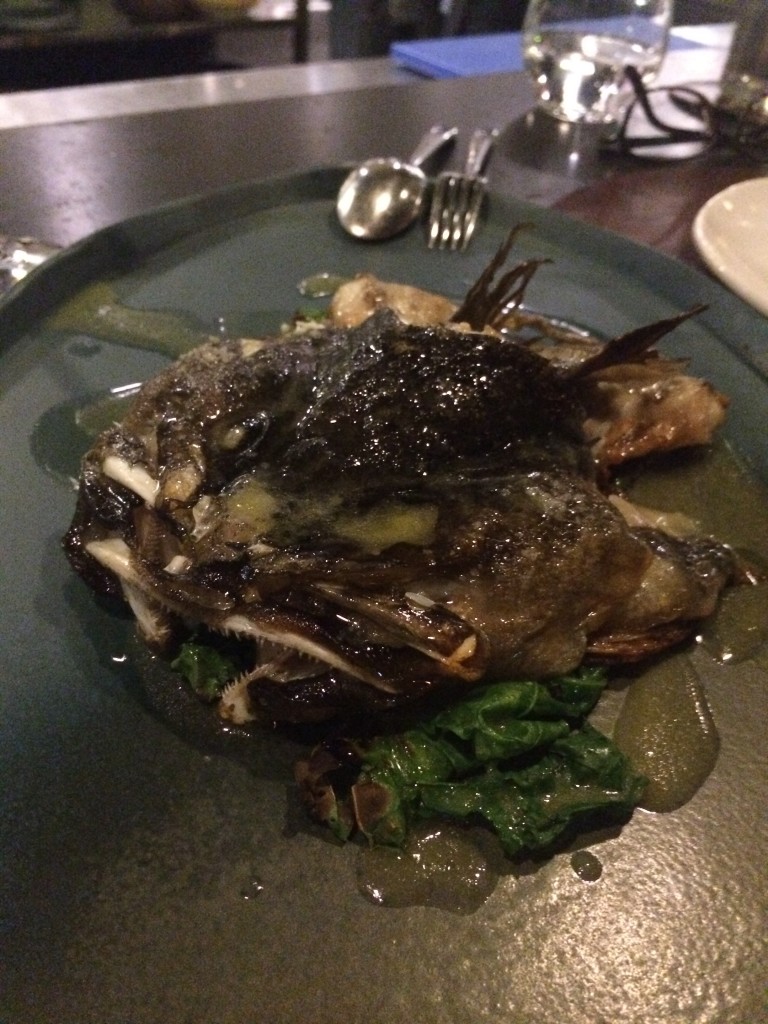
 The Murray codhead (first photo above!) was probably the most challenging; there wasn’t a lot of meat, and the
  gelatinousness of it was its pitch. But I couldn’t bring myself to suck back the eyeball. Cheeks are always good though.
It made for a dramatic visual.
The squid was so tender and delicious, and the squid ink puree with a hint of tomato and (what was that secret ingredient the waiter told us?). Regardless, simple and delicious.
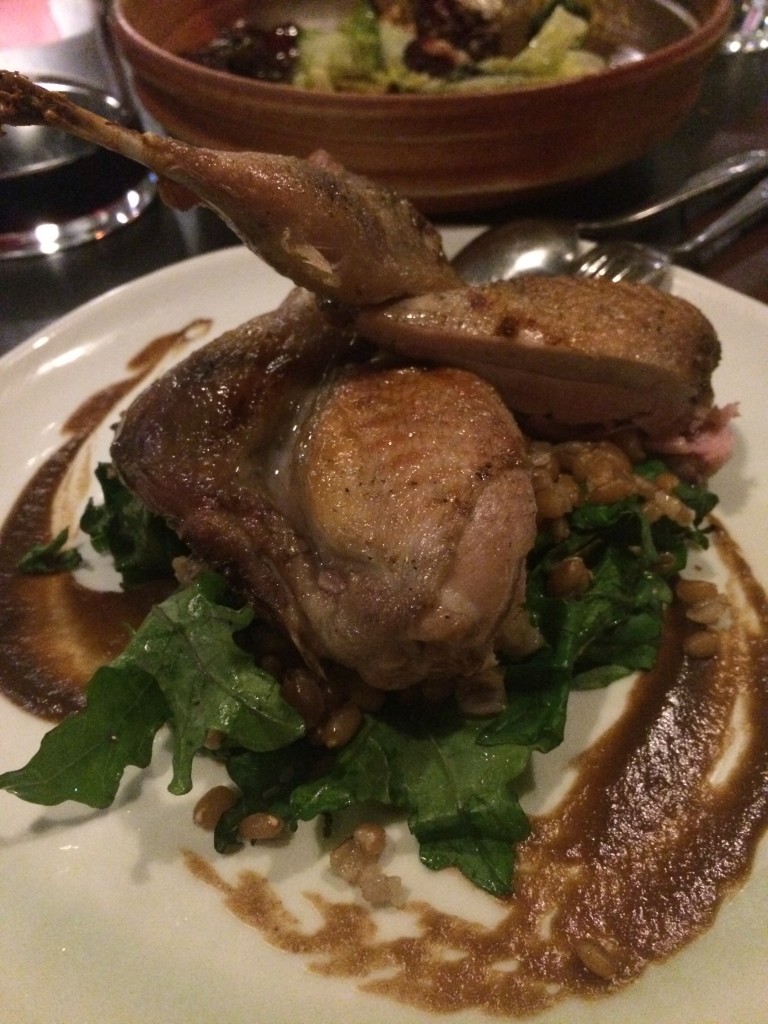
 A simple salad preceded the Jurassic Quail, which owner-chef Lennox Hastie (great name) told us was the most beautiful of quails that he’d encountered, killed on a Tuesday, brought to them on a Wednesday. It was indeed more tender and bigger than any quail I’ve tasted – and delicious. With spelt and kale, yummilicious.
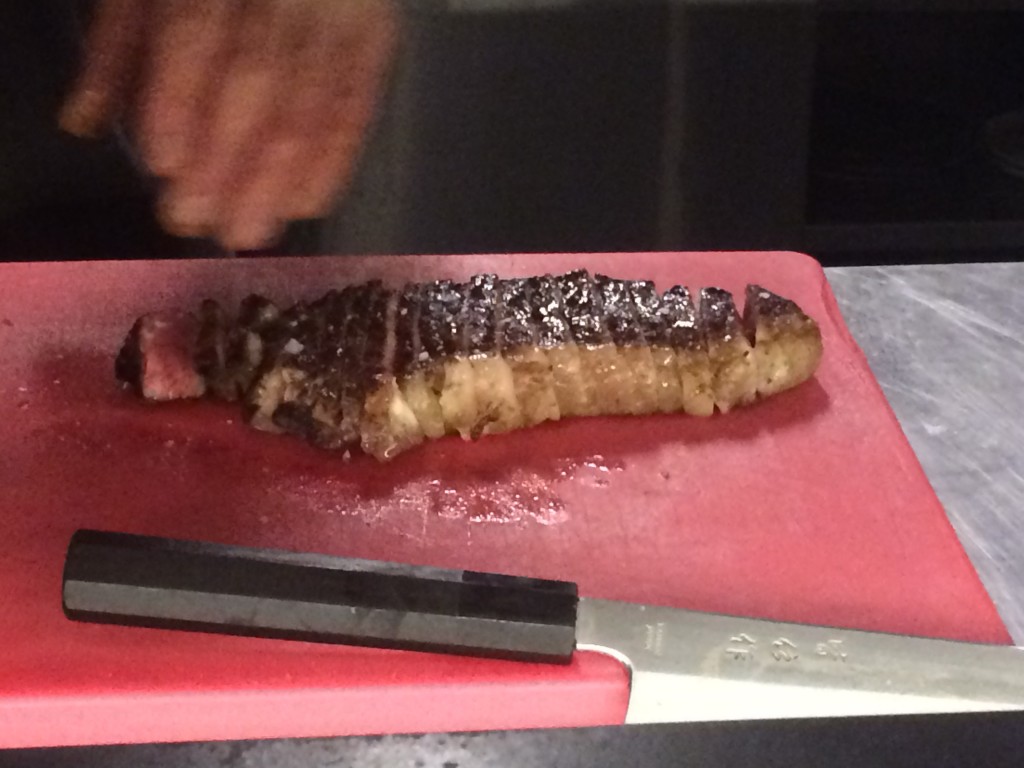
As my fabulous dining companion doesn’t eat red meat, we had to skip what is apparently the restaurant’s specialty, which we saw being cut each time it was ordered, and then grilled to perfection and then cut into pieces by the head chef (who was friendly and engaging and also made our evening more memorable, watching him work, and being able to ask him about some of the dishes).
We’re coming back in January to eat THIS:
With all that heat coming from the kitchen, a cool dessert was a relief; and it was a marvelous combo of textures and flavours. The wine list is extensive here, and a little pricy (as you’d expect for a top-end restaurant) but they serve a surprising amount of them in a carafe, which I think is a nice option. We had a yummy Orange wine which got better the closer it came to room temperature followed by a carafe of a French wine, light enough to pair with the seafood. 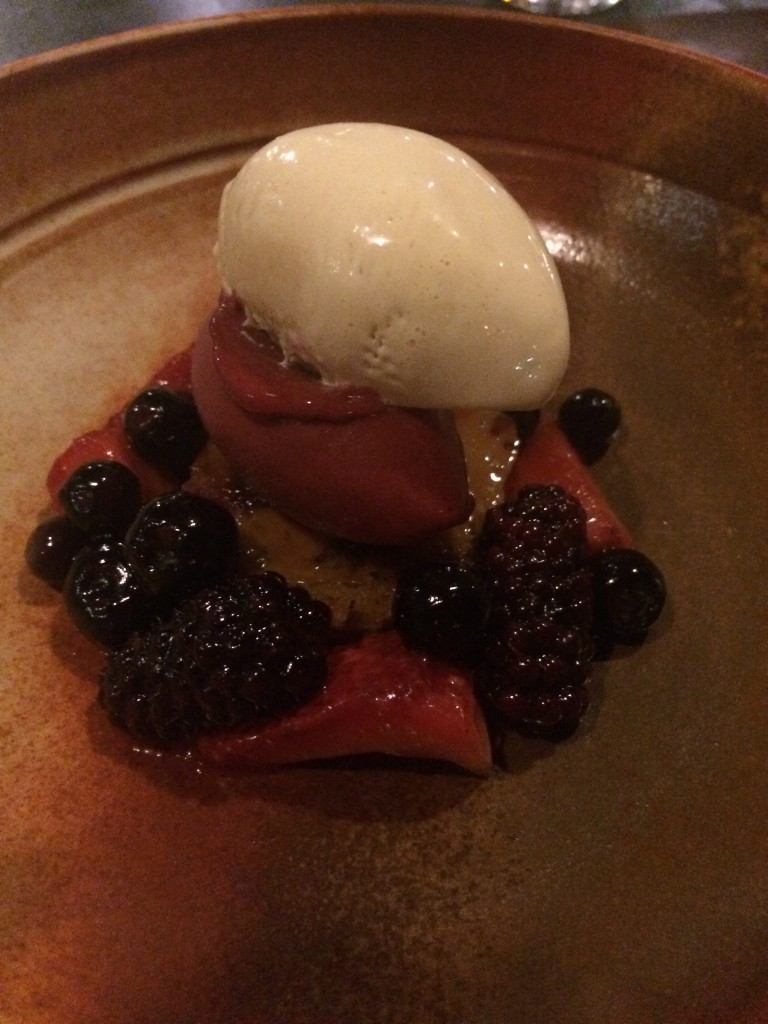
I haven’t given a 5/5 rating here since Quay, but why would I be mean with stars after such an amazing evening?
PART TWO!!!
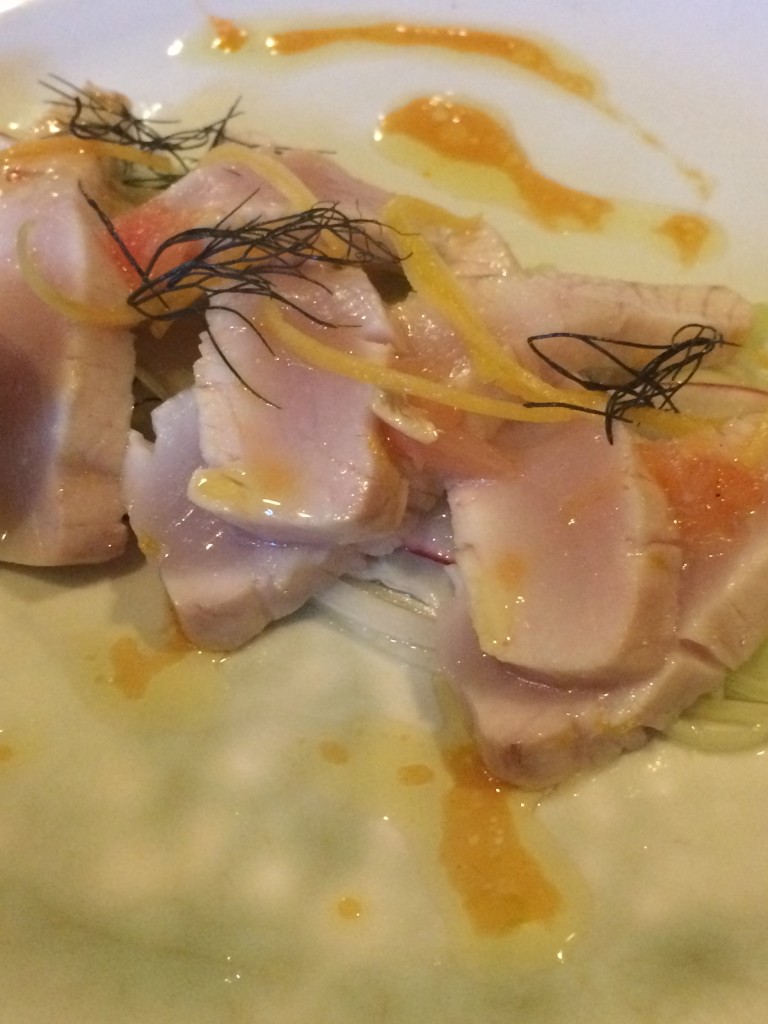
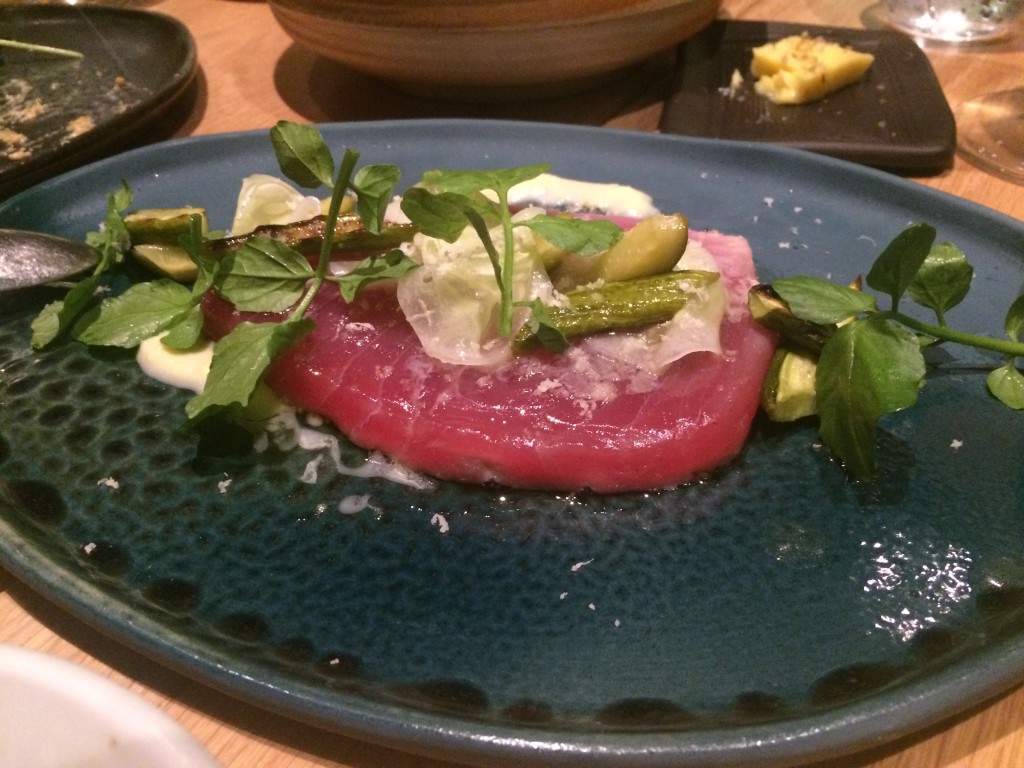
As warned, we returned in January 2016, ready to try that steak. This time, with some experience under our belts, we ordered various dishes rather than do the tasting. And also had some very tasty wine. As before, the food – all of it – was amazing. We missed the fennel and white fish from the last time, but how could we complain with this delicious tuna.
We repeated the beans, just as good as last time, and the toast with smoked butter, and also had this snapper. Yum!
And of course, we tried this. Meet the over 165 day dry aged rib on the bone, all 500 grams of it. I told my brother, who is a meat broker, about this (yes, seriously, he is a meat broker), and he said the industry standard for aging is 3–5 weeks (I think he told me this). By 165 days, he said, the fibre of the meat would be so broken down that it would melt. Like butter. 
And by god, yes it did. On the previous visit, I’d thought he’d been cutting frozen meat in the corner, but no, that’s what it looks like after so long ageing. It was beautiful pink inside, but I could not detect any blood, any toughness. It was this intensely meaty, very rich, buttery, grilled, fat… thing and I’ve never tasted better meat. For $138, we split it between the three carnivores… and were in heaven.

 friends, is a very Australian thing to combine a hotel and bar, and is the reason why so many of the pubs in Sydney (and elsewhere in Australia) have the name ‘Hotel’ in them. I’ve actually stayed in accommodation attached to pubs twice here, and the only possible advantage of staying in a not-great room with a noisy bar below it is if you want to get so drunk that you can’t go further than a set of stairs.
 This last visit to Shakie’s coincided with a trivia night upstairs. We’ve decided this is the go-to location for our alumni gatherings as the meals are cheap enough for folks on a budget, and it’s close enough to Central Station that people can get to it from many parts of Sydney. Food specials are $12.50. Yes, you read that correctly. And the drinks are fine. This time I had the chicken schnitzel (it took me over ten years here to hear the Aussie nickname: schnitty; this particular one was crisp, tender, smothered in tasty salty gravy on top of mash and a nice coleslaw on the side). The time before it was chicken parmigiana but I’ve tried other dishes on the menu, and it’s tasty, fresh and cheap, in a fun and unpretentious atmosphere. For that, it gets four stars out of five!

 There’s always something new to discover by randomly choosing something that sounds good, and I find the food tasty and the portions generous. A recommendation on Zomato said the biryani was tasty, and indeed it was: surprisingly light for a rice dish, though it was such a big portion, it overwhelmed all else. I’d say order one of these only if you’ve got a table of at least four and maybe more. The deep-fried okra to start with was tasty and unusual; the tandoori fish beautiful. A classic yellow dahl was really good.
 I’ve had meat dishes here on other occasions, which were tasty too. All for a very reasonable price ($30 a head) and BYO. The service was friendly and efficient, though
  because they’re so busy (also managing take-away orders), it can be hard to get their attention. Very pleasant. My current go-to South Asian restaurant.
 Sunday lunch, on the terrible day after the events in Paris, it seemed appropriate to discover a French cafe in my neighbourhood, and perhaps in a misguided way to show support. With a name like Buster Brown, who knew? But they had a nice little chalkboard that clearly said it was a French bistro, and more than that, it was nice to hear that the majority of staff were French, though I didn’t feel up to chattering with our waiter (who had a fantastic accent) about what had happened.
 I just finished reading Malcolm Gladwell’s Outliers and came across a passage that struck me.
 Bolstering the theory of rice cultivation = hard work and smarts, he said the lowest-achieving Chinese-Americans were the
  A
A 

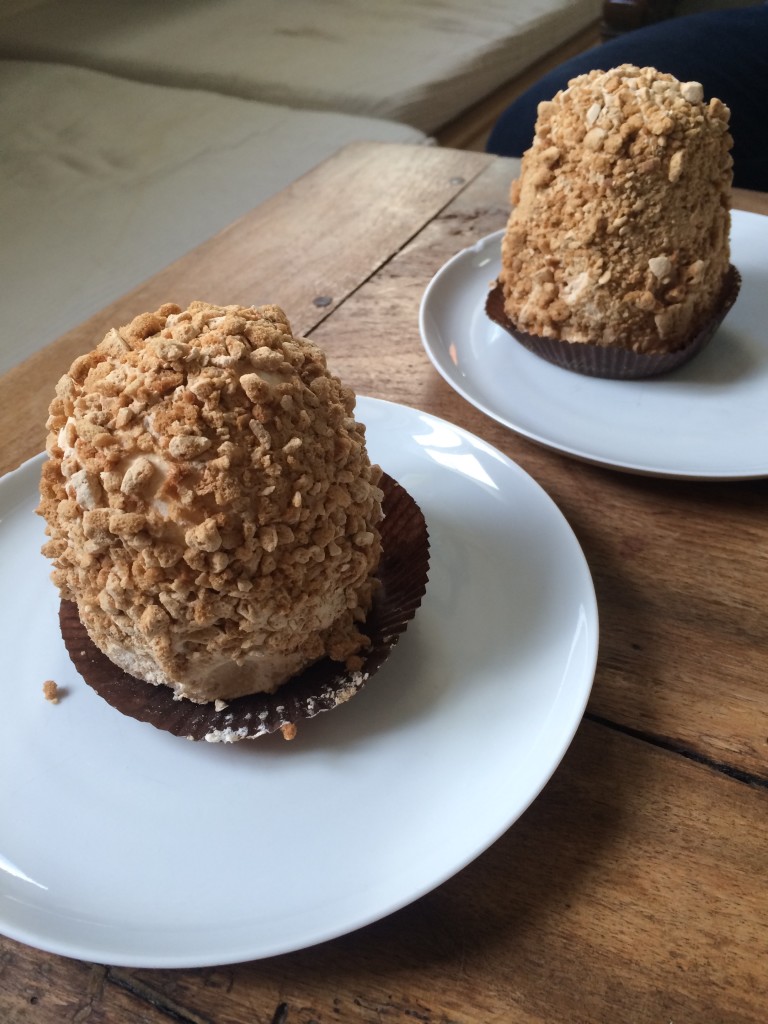 At a subconscious level, it’s obvious that the reason for my keeping this recommendation private, given directly to friends or posted on Facebook, is that I can’t imagine that something THIS GOOD is so easily available – if one lives in Paris, or as I hear, London, New York and Brussels – and that the information must be hoarded.
 think the meringue is filled with the cream as well, but I’m not 100% certain. It is a marvelous combination of texture that somehow alludes to what it is not: surprisingly not heavy nor too rich nor too sweet.
 Macarons are still everywhere in Paris, but seem to have hit the peak of international interest and are falling away. When McDonalds serves them, they’ve ceased being a novelty! Sadly though, their widespread popularity makes it easy to forget how good they are when bought from Paris’s top vendors like Pierre Hermes. But if I had to give a single recommendation for a Parisian pastry, I’d reluctantly nudge aside the macarons, and boldly predict this as the new trend to