Here’s Kamahl

[In 2009, I had the great privilege to interview one of Australia’s music legends, Kamahl, for Peril Magazine. I recently checked on it to share it with a friend who was recently hanging with Kamahl… and discovered that their archives have screwed up the article completely. It’s missing the last half, and the additional material is scrunched into the comments. Oh well. For posterity, I’m moving it to my site here:]

Here’s Kamahl!

Kamahl laughs when I remind him of the reason for this interview, but none of us at Peril knew, long ago when the theme of this issue was chosen, that Kamahl would soon be thrust back into the spotlight.

“Let me tell you the origin of that phrase,” he begins in the voice that made him famous. I could try to describe its depth and resonance, the way it draws you in, but most of Australia, as well as international fans, know that already.

Flying out from Amsterdam from a November 13th birthday reception his record company had thrown for him, he arrived in New York and met Jimmy Bishop, the A&R manager for Sony who had a number of cassette tapes for him to listen to.  The one that caught Kamahl’s ear was called What Would I Do Without My Music?. “I kid you not,” he tells me, “when I first heard it, maybe I was tired, I had tears in my eyes listening to it. It was almost like a prayer.” It reminded him of a Schubert Lied that he explained said thanks to music for taking us to a better world.

“But the more I listened to it, then I became slightly critical. The lines were: sometimes I stumble home at night, discouraged, wondering if the battle is worth fighting and why people are so blind? I thought that kindness is more significant than blindness and without consulting the composer, I took it upon myself to change it and to this day, I haven’t been sued!”

Kamahl recorded the song, and performed it on the Bob Hope Show as well as various Australian shows. He can’t pinpoint who it was who did it, but he says the phrase got pinned to him like a donkey’s tail, as a Unique Selling Proposition with its ups and downs, “a handlebar for me”, mostly positive but “every time I see someone young or old, they say, ‘hey Kamahl, why are people so unkind…’”

He brings up Hey, Hey It’s Saturday without prompting but stumbles trying to explain. “Unfortunately, the show has never been to my advantage,” he says finally. “I used them, and they used me. On hindsight, I would have been better without it.”

The Jackson Jive skit was unfortunate for different reasons. “What really got under my skin,” he tells me is that there were two milestones this year, the 50th anniversary on 17 October, 2009 of his first appearance on television, and the 40th anniversary of his first hit record, The Sounds of Goodbye. But there was no media attention or respect. At the same time, everyone was asking Kamahl whether he would appear on the Hey, Hey reunion. He didn’t expect an invitation as he wasn’t part of “that family”, he was a guest performer “more off than on.”

The organisers waited until the eve of the first show to make the invitation, which clashed with a previous commitment to his charity work with the Variety Club. They invited him for the next show, but to do what? “You can sit in the Green Room,” they told him, “after you find your own accommodation and pay your own airfare to get here.” Compared to the respect shown to him through the Variety Club, who had named him one of their 100 greatest performers of the century, it was a poor showing. When the infamous show was aired, he wasn’t even paying particular attention to it. He saw the replay of the Red Faces skit, and was annoyed at the cartoon of him saying “Where’s Kamahl?” but forgot about it. They had done similar jokes before.

Kamahl didn’t think the sketch was really racist, “ it was purely something in very bad taste… a slight lapse of judgement… and also Michael Jackson having passed away a short time ago…”

Then Kamahl got an e-mail from Channel 7 the following morning asking whether he wanted to make a comment. His wife said, “the show was good for you, aren’t you biting the hand that fed you?” He replied, “Frankly, they never fed me, they never promoted my career, they used me to make jokes out of. I don’t think that show ever helped me sell a record.” “Being on television,” he tells me, “people recognise you, but what they think, what their perception is, I don’t know.”

“So, the guy came in for the interview – and I didn’t tell them the real reason why I was disappointed…the guy was trying to get me to say that Australia is a racist country and I was trying to say we are no more racist than anyone else. I didn’t even bring up the point. My wife said a few months ago the Indians were being targeted in Melbourne and I stood up to say that’s not an act of racism, it’s about being in the wrong place at the right time, other aspects… so cut to this, as he was leaving at the  door, he said ‘are you going to sue them?’ and I said [in a joking tone] ‘that’s a great idea.’  Front page next day. And with that, an avalanche: some very upset people that I was being a hypocrite and at the same time, a majority of people who said heartfelt things about me speaking up and them never feeling comfortable about [Hey, Hey] taking the mickey out of me.”

I said I can imagine a defense from Hey, Hey saying that they take the mickey out of everyone. But he rebukes me, “Not everybody. They crawl to some. They take the mickey out of who suits them. They never took the mickey out of Jimmy Barnes, John Farnham. That’s not true at all.”

An example: on the eve of his performance at Carnegie Hall in 1984, Kamahl was pelted with a powder puff on a Hey, Hey Saturday show. A friend of his, an Australian living in Nashville, saw this on youtube only last year, and told Kamahl, “I’m ashamed to be Australian. How could anybody treat any of their artists the way they do?”

I press him, “what was it like to be the only splash of colour among a sea of white entertainers?” without realizing how my question echoes the pressure of the Channel 7 reporter to lay claim to being a victim of racism. So Kamahl tells me of an earlier interview where he announced “No one has asked me whether I am racist or not!” He frankly admits as a young Tamil Sri Lankan Malaysian arriving in Australia in the 1950s that he was also a product of his time.

“Til Cassius Clay [aka Muhammad Ali] said Black is Beautiful…I didn’t realize they were a beautiful people… Suddenly you stop and see and think and you perceive.” Who would have known, he went on, that the greatest interpreters of Western classical music would be Asians like Yo Yo Ma, Zubin Mehta and Lang Lang. But years ago, he would have thought Asian musicians inferior. “We grow up with a whole set of false prejudices and then it’s up to each one of us to check these bits of information to see if this is really true.”

At the same time, he acknowledges the effect of being a racial and cultural minority as profound:

“My whole purpose of getting into show business was not so much to sing, as it was to communicate, because of my ethnicity, being black in Adelaide in Australia in 1953 and 54, it was a very different experience, not like now. The few of us Asian students at King’s College would be the only few non-white students. It made me extremely self-conscious and shy, and I try to avoid talking about it, but there’s an inferiority complex – you don’t have to be black to have it – even now, if I go into a room of strangers, the old doubts and fears come rushing back…It’s a feeling that as a non-white person, you’re of little or no consequence, and that’s what the Australians thought of the Aborigines 30 years ago, they were regarded as no more important than cattle, and I identified with them. So I have great sympathy for their plight, and I’m sort of caught between them and a white man.”

But he notes changes in Australian society: “On a daily basis, a majority of Australians have become more inclusive, there’s no doubt about it, especially in the cities, in Sydney, it’s truly cosmopolitan.”

So, many years after his first successes, it seems that Kamahl’s life continues to be a combination of hard work and personality, and chance, this latest media flurry from an offhand remark. This much-loved Australian icon has received a divided response about the Hey, Hey incident. “Some people say, get a life and don’t worry about it. Partly because I should have at the very beginning said that it would have been nice to have some small gesture of respect instead of derision.”

The flurry of headlines in early October in the Daily Telegraph and ABC news portrayed an angry man “threatening” a lawsuit; on the contrary, it seems to have been an opportunity for reflection on where he stands in today’s popular culture. He would have liked to handle the incident better. “But,” he laughs, “then I would have missed out on the front page.”

At the end of the interview, I tell him what an extraordinary career he’s had. “Yeah, from your point of view, but for me, when you have lived it, it doesn’t seem all that,” he replies in that voice which is anything but ordinary.


Posted in Stuff | Leave a comment

Terrible Gay Films: Keep the Lights On

It makes sense, when one is in a minority, to seek out images and affirmation of the group one belongs to. So, gay film was certainly a part of my coming out process, and a way to explore and affirm my new world of being gay. I celebrated when films with gay themes received mainstream attention. I traded stories with friends about films that had influenced our lives.

But part of this journey was watching terrible gay films. The seminal experience was watching a 1990 film called “Men in Love” as part of the gay film festival in Vancouver. In one scene, at a funeral, the bereaved are about to release balloons into the air and the minister stops the proceedings to lecture them on how the balloons will deflate and fall into the ocean and could choke dolphins. Seriously. The other major standout scene was a tantric lovemaking scene, designed to encourage gay men to have sex without penetration. Filmed in slow motion in a sunlit room with white sheets and furnishings (sort of like a gay tampon commercial), the impossibly muscular and handsome lead actors frolicked with each other, laughing with… a kitten wandering around on the bed, dangerously close to getting squashed by their activities. I remember none of the story but that the acting was terrible and the film make-up was visible on the actor’s faces in some scenes. I fled the theatre before the Q&A session started with the director and writer.

Since then, there have been countless more at gay film festivals, low budget and b-grade, and a predominance with descriptions like “Incredibly muscular former hustler gets into trouble with his ridiculously handsome gym trainer boyfriend when he falls for a gay porn star fighting a crystal addiction. Features sassy, straight best girlfriend, a cameo from [insert name of American sit-com actor].”

However, the latest terrible gay films confound me. The one I saw last night, as part of a film festival on Cockatoo Island, has apparently made the circuit of gay film festivals BUT has been widely reviewed and praised in the mainstream press. Esteemed film reviewer, A.O. Scott, in the New York Times (!) called it ‘thrillingly authentic’ and ‘so real, so specific’ while one of my favourite reviewers, Andrew O’Hehir from Salon called it ‘easily the finest dramatic film’ that he saw at Sundance this year, and ‘a terrific work of art’.

Granted, it had promise to begin with. With beautiful cinematography, a naturalistic style of film-making and storytelling, some engaging acting and a typical indy-music soundtrack, I was interested in Erik, the Danish documentary-maker (it helps that I love the Danish) and his relationship with Paul, a literary agent for Random House, addicted to crack (though I kept translating it in my head to today’s meth addictions).

After the first segment in 1989, I realised quite quickly that this was an autobiographical movie, and that the lead character was a stand-in for the writer (in fact, I wondered if perhaps the lead actor was also its director and maker).

This was the first big problem. The various scenes used to tell the story of a relationship over 9 years or so do feel authentic, but that doesn’t mean they add up into a good story. It felt like recounting memories, with snippets of conversation, and pivotal moments of drama, but it didn’t add up to all that much.

The worst of all is the characters themselves. Initially interesting enough, they don’t evolve in the whole time they’re together. Perhaps trying to age them physically might be difficult, but to have them with the same hairstyles and clothes OVER NINE YEARS felt lazy. A fellow filmgoer said ‘I wanted to rip Paul’s canvas tote bag off of him’; the same one he seems to carry year after year.

But more importantly, there’s very little emotional growth. Erik is dramatic and emotional, and sometimes childish. Paul is unable to express himself, and is basically a crack addict with little other colour. He somehow manages to hold onto his job while he disappears for days at a time, or longer.

Their main personality characteristics are that they have hot sex with each other, and can’t seem to stay away from each other. Even near the end of the film, when the filmmaker demands a ‘talk’ while the publisher is on the phone, it’s the same emotional note as the beginning: he’s dramatic, emotional and a bit childish. The response from Paul is also exactly the same as in the beginning: I can’t talk about this, I have to go to work, this is all… very… hard to talk about.

But is this the gay equivalent of those terrible straight rom-coms, where two people are simply meant to be together? In my experience, people change. Attraction rises, dwindles, takes different forms. The idea that Erik has the same sort of response year after year to Paul’s drug addictions speaks little of any depth of emotion or relationship. Meanwhile, Paul gets worse, gets better, and comes out of rehab without seeming to change in any particular way.

In fact, the people and the relationship portrayed in the film did feel authentic and true, and yes, people get stuck in relationships and patterns. The problem is that neither character in the end was very interesting or sympathetic. It was hard to care about them, and the general consensus of the seven friends I saw the film with was: none of us did.

A couple of straight people left the movie as the film dragged on. I’m kind of guessing that the rest of us, the gay men who made up the majority of the viewing, were wishing we had done the same.

What’s going on with film reviewers these days? Are they swayed by colour and movement over better-written characters and a better way to tell their story? Or do cool straight people fear being homophobic if they were to actually point out that these two gay main characters, in spite of the sex they’re having and drugs they’re taking, are not very interesting?

Posted in Film, Gay Life, Review | Leave a comment

Book Review: Paul Kane’s Work Life: New Poems

Work Life: New PoemsWork Life: New Poems by Paul Kane

My rating: 4 of 5 stars

Poetry is mostly undercover these days, so I think it’s interesting how you stumble across a book. I happened to be at a reading in Glebe in Sydney, Australia where three poets had been invited to read, Robert Gray, Kevin Hart, and Paul Kane. Kane was the poet that I hadn’t heard of but I found his reading engaging, both lyrical and light-hearted, and I decided to give his book a try –

Which is one of those great strokes of luck, when you find a poet who you like enough to vow to search down his or her other books, and whose work you really, really like.

I really enjoyed ‘Work Life’. While the voice is consistent, I like the range of subjects treated in the 5 sections of the book: the forbidding and political first, the elegies of the second, the long poem “psyche” in the third, nostalgia and teenage years and the hilarious two-liners in the fourth, and a final section that gathers together religious imagery and myth.

Kane’s intellect and wisdom is evident, as is the breadth of his life experience: they manifest in lines that are clear and accessible and at the same time complex in idea. I like that I don’t have immediate comprehension of “Psyche” or some of the other poems – that I’ll have to work at them, faced with intelligence greater than mine.

At the same time, I marvel at how he takes a few plain words and transforms them with poetic ability to something magical: “What are we to ask of a shadow? / At noon, night flickers around us / as we walk in the cold sun’s light.” (‘The Night Heron’). I find this simple, graceful and bloody beautiful.

And though I’m perhaps making Kane sound like an intellectual poet, his work is full of feeling as well, a tenderness that in lesser hands would come off as sentimental, but I found resonant and touching. “What do I owe / the past”, he writes in ‘Third Parent’, “except to settle the accounts / I bring into the present as my special sorrow?”

View all my reviews

Posted in Book Review, Poetry | Leave a comment

Our culture stagnating

Ages ago, a friend forwarded me an article from Vanity Fair.

From January 2012, Kurt Anderson argues that our culture and style has stagnated in reaction to so much technological and political change (we’re exhausted by change and hang onto nostalgia instead) AND because our economy benefits from recycling trends rather than from true innovation.

A long but interesting article.

We seem to have trapped ourselves in a vicious cycle—economic progress and innovation stagnated, except in information technology; which leads us to embrace the past and turn the present into a pleasantly eclectic for-profit museum; which deprives the cultures of innovation of the fuel they need to conjure genuinely new ideas and forms; which deters radical change, reinforcing the economic (and political) stagnation. I’ve been a big believer in historical pendulum swings—American sociopolitical cycles that tend to last, according to historians, about 30 years. So maybe we are coming to the end of this cultural era of the Same Old Same Old. As the baby-boomers who brought about this ice age finally shuffle off, maybe America and the rich world are on the verge of a cascade of the wildly new and insanely great. Or maybe, I worry some days, this is the way that Western civilization declines, not with a bang but with a long, nostalgic whimper.

Posted in Stuff | Leave a comment

Sydney Food Adventures: Momofuku, Star City (first visit)

I was completely surprised, after hearing about how difficult it is to get into Momofuku, to log onto their internet reservation system on a Thursday morning and have a spot come up for two nights later, Saturday night at 8pm. Woohoo. We must have got a cancellation.

Immediately, I received confirmation of the reservation and at least two other e-mails warning me that if I cancelled unexpectedly, they’d charge the full cost of a degustation to the credit card number I’d given them. Then another phone call or two to confirm we didn’t have any food allergies or issues. It certainly felt like an event!

Perhaps because I hadn’t been paying attention, I didn’t know how small the restaurant is, a handful of tables, and the majority of folks seated around the kitchen, as if in a Japanese restaurant. Fun. I blanched slightly at the cost of drinks and funnily, no one told us how much the tasting would cost – it ended up cheaper than I expected at $175/head; matching alcohol was another $90 I think.

I missed taking a photo of ‘snacks’: blood, nori, mochi and smoked eel. The blood was like a rice cracker made out of blood pudding. Little roasted mochi cube was tasty and reminded me of my last trip to Japan. Here’s the real first course though, what Momofuku is famous for: a steamed bun with pork belly, cucumber, hoisin and srichacha sauce on the side. Pretty perfect, really.

Next was a striped trumpeter with pomelo and pistachio. Interesting texture of the pomelo, which I don’t really like in its whole form. I missed taking a photo so we skip to marron with burnt eggplant and rhubarb. Beautiful, no? One of my favourite dishes of the night. Burnt flavour was a bit intense though.

This dish was prettier than it tasted. Bits of wagyu beef in fermented black bean paste with radish slices. The paste is an odd flavour, and the beef was unmemorable. Weird. Friends be warned. I’m going to construct radish garnishes in this way sometime in the future for you!

But following that was a dish that was also unusual, but one which I though was one of the best of the night. Potato roasted in beef fat with quandong and bottarga, dried mullet roe, which we’d seen in a challenge on Masterchef only a little while ago! It was such an interesting use of ingredients and flavour combination.

What next? A little egg custard with toasted rice tea and brown butter:

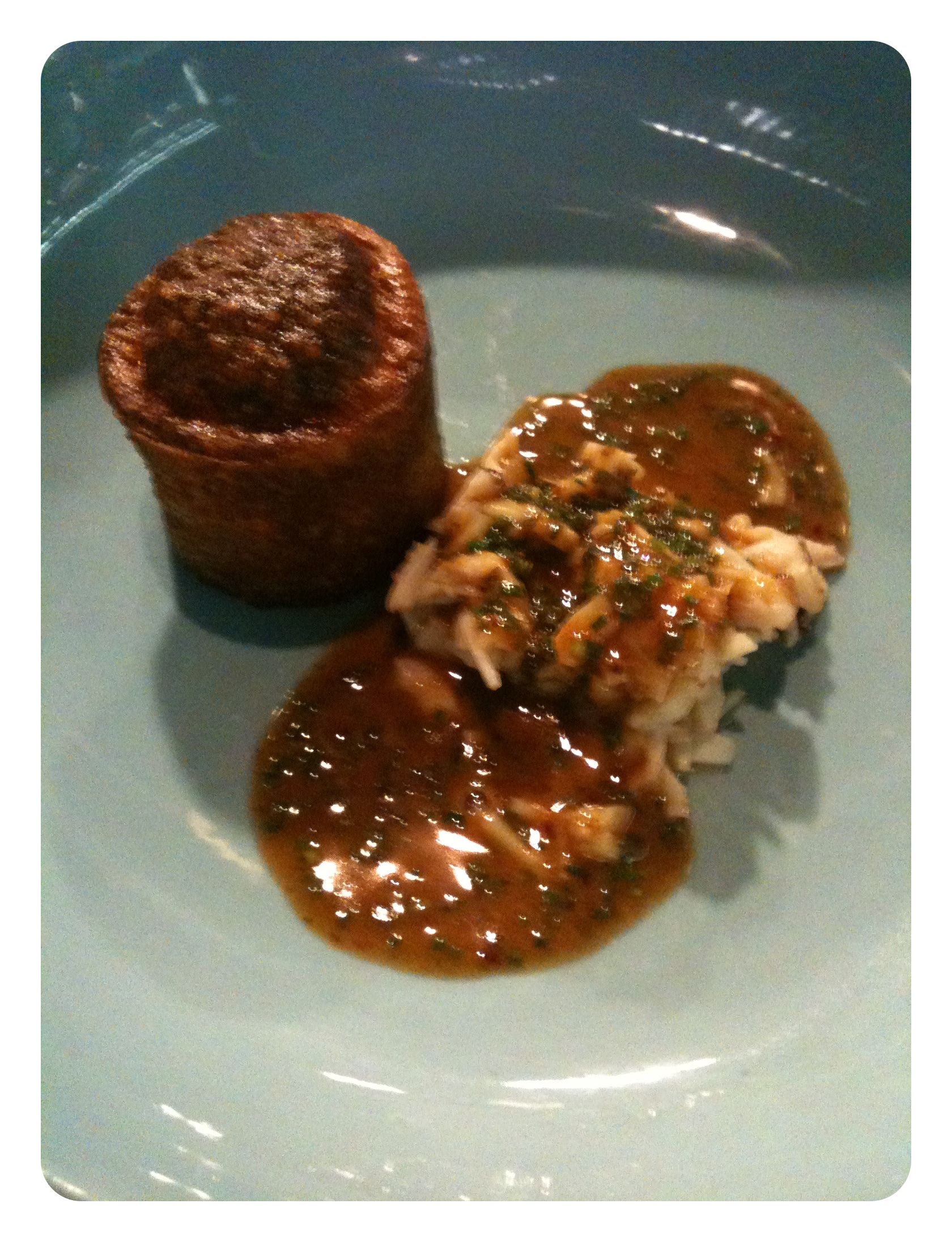
And then another of my favourites of the night. Mud crab with old bay and yorkshire pudding. Holy cow. Lots of flavour. Absolutely delicious and rich. And playful to change a traditional dish like roast beef and yorkshire pudding and put in crab instead.

The pink snapper with periwinkle and chrysanthemum perhaps sounds more interesting than it was. The periwinkle, shaved, didn’t make much of an impression on me.

The beef cheek that followed was another favourite – wow, tender and melt in your mouth but it retained its form. Accompanied with cucumber and artichoke.

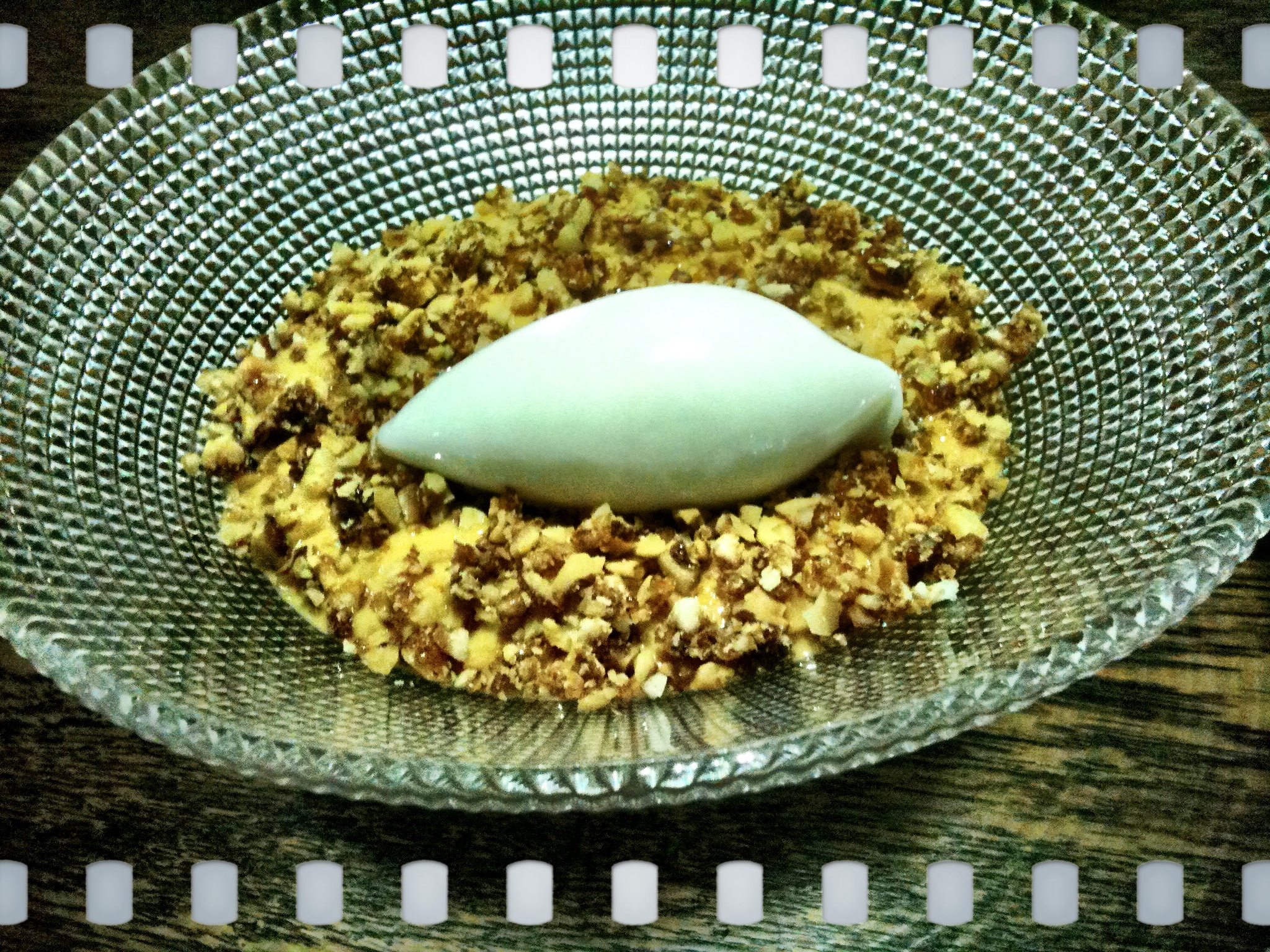
The home stretch. ‘C2’ with honey licorice and bee pollen was the first of the desserts courses, followed by a pear with yoghurt, sultana miso and whey:

Er. and another dish that I don’t even remember now: potato with muntries (a native cranberry) and muscavado. At the time, I thought it was interesting to have a potatoe in a dessert. And then, the final ‘dessert’. Slow cooked pork in a sweet sauce, to be eaten with the fingers! (matching sherry…)

Now, this is my kind of restaurant.

Sorry for the poor quality of my iphone photos by the way.

Now, what I didn’t get photos of was my highlight. The matching alcohol was perhaps the most inventive and engaging matches that I’ve experienced. Starting with a sake, it went to a cloudy organic white. There were a few more whites that tasted old and interesting and only one red. There was a sake made by a woman master (unusual apparently) from red rice. And the final Pedro Ximinez sherry, 20 years old I think, poured like thick black vinegar and tasted like… heaven.

And the other highlight was sitting around the chefs, watching everyone in action. It’s theatre of a sort, and probably doesn’t suit everyone. We were fascinated, and it does bring a different appreciation of the food to see how it is prepared, plated and presented.

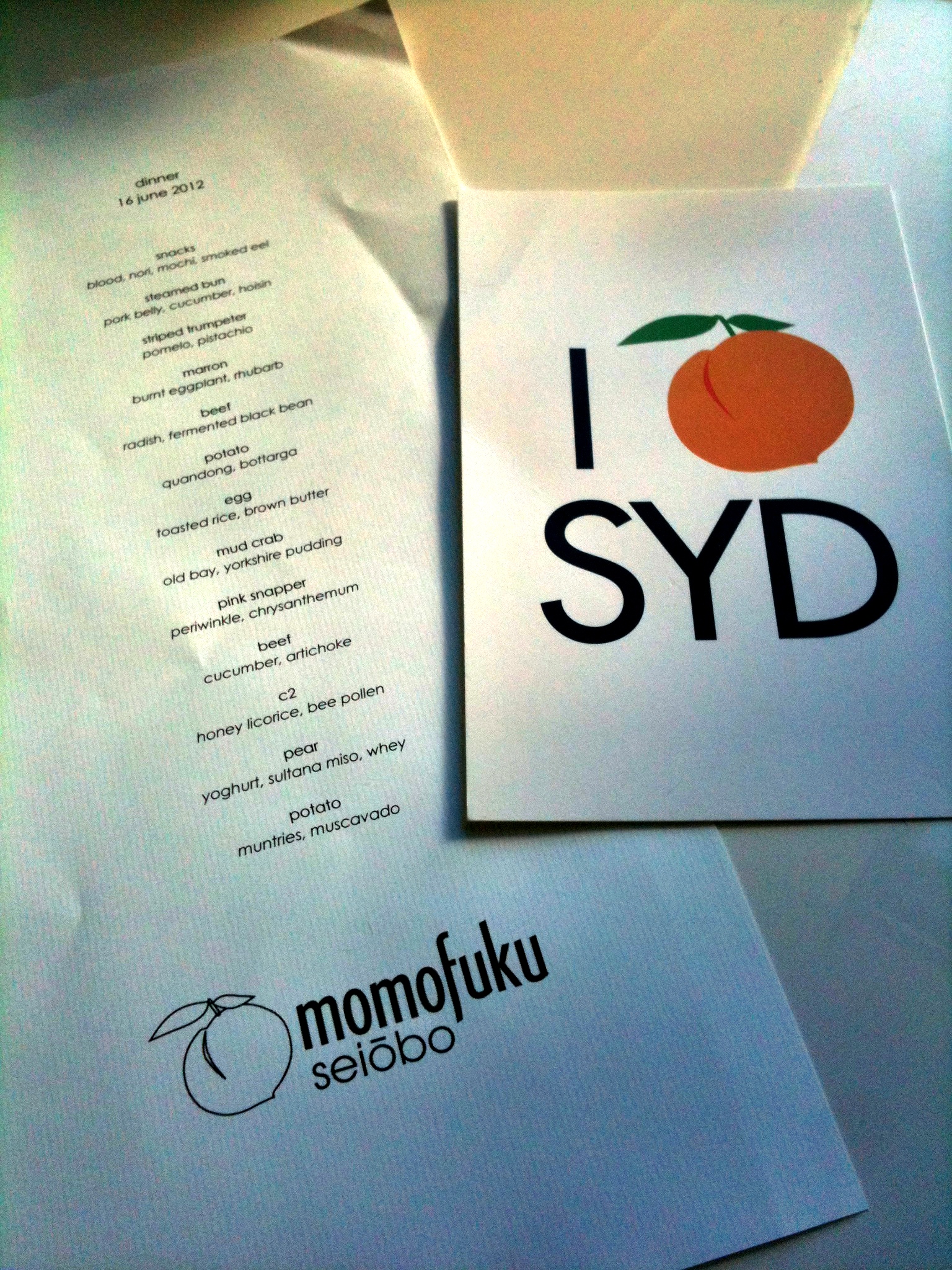
At the end of the dinner, we got two little packets of kim chi as souvenirs, the menu of the evening and a postcard.

It was a great night, an eventful one that matched our mini-celebration. There were a handful of ‘wow’ moments, and I think I might have been expecting a few more – my first reaction to a number of dishes was ‘interesting’ rather than OHMYGODTASTY. But perhaps I have more conservative tastebuds than I know. I’m not sure when and if we’ll go back BUT I’d definitely recommend a visit for a special occasion.

[The latest review of Momofuku Seiobo is here].

Posted in Asian, Food n' Grog, Sydney | 1 Comment

What I learned in voice class

I just finished 8 weeks of ‘Contemporary Singer 2‘ class at the Sydney Conservatorium of music with Edoardo Santone as our teacher. Final concert was last week! Phew. It went well.

What I learned

  • My past singing didn’t given me experience with using a microphone or singing in a pop style.
  • That’s because most of my singing was to myself at the piano where I sing inward and inside my head (or sing at the back of my throat as another singer teacher told me)
  • Or because I sing in choirs, where we project to the audience
  • Or to friends or small audiences, usually without a microphone, where I feel I have a need to project myself and my voice in order to be heard.
  • And finally, I sort of gravitated to the musical style anyways, because I love them so.
  • The result is that I often sing as if I’m on stage in a broadway musical, where I’m projecting out to an audience, and at a good volume, without much tonal variation and really good enunciation.
  • So, I learned in Contemporary Singer 2, from Edo, how to sing quietly into a microphone, but my mouth right up to the mic, and to experiment with quieter, breathier lines.
  • I also worked to get rid of some of the enunciation of choirs and showtunes, to not hit those consonants so hard, and to try to be breathier and mumblier.
  • Oh, and when I sing loud, to move the mic away from my face a bit…
  • Preparing the two songs in eight weeks for a performance was a good experience. It forced me to memorise one of my songs, and I now know it backwards and frontwards. Because of that, it allowed me to focus on emotions, dynamics, and the shape of the song. I think of all the past recordings that I’ve done of my songs, and the disservice I did to them by not memorizing them – that I gave ‘good’ performances off of my sheet music, without going to the next level.
  • Singing ‘Ordinary People’ by John Legend was a great experience, very different than anything that I’ve sung before, so to try to adopt and adapt the pop-soul sounds of him (or of Jerson Trinidad, from the Voice Australia, the other version of I listened to) stretched my voice and style. Memorising it and learning it well for the performance allowed me to think about the shape of the song, and play around with tones. I even managed to sing some falsetto to close the song, which sounded OK, something I’d never have tried before (and certainly not without a microphone).
  • Working on the two songs pointed out to me other lessons to learn: I really don’t have much facility to do small pop licks, and bend individual notes and phrases so they sound richer, more interesting, and more soulful – as a handful of other students could do; I tend to hit them straight on like choir notes and show tunes, which is fine, but I’d like to be able to stretch.
  • And preparing for a performance, and performing was a good experience. I’ve mainly performed with a piano in front of me, or as part of a choir, so to sing a solo song with a piano accompaniment (by Edo) was very different (and very fun) and even performing my own song on piano felt like a different experience, having prepared so much and in a nice space that was set up properly so I could generally face the audience (often a problem when playing piano) and with the mic set up perfectly. Oh, also the audience was a nice size, maybe 25 people? And it helped my performance to feel how supportive they were.

Stay tuned. I’ll try to post a video or two of our final concert.

Posted in Music, Stuff, Sydney, Theatre/Concert Review | Leave a comment

Restaurant Review: Tomislav

Without any planning, S. and I decided to go out to a nice meal. Friday night in Sydney. It’s not always easy to get into places that are popular.

So I had little hopes of getting into Tomislav, a restaurant that I’d wanted to try after reading a great review in the Sydney Morning Herald, and also a good report from my pal, John. The chef is Australian-born, with an Eastern European name, and making inventive Modern Australian food. When I called to make a reservation, the fellow on the phone told me that with the weekend ‘Taste of Sydney’ event on, restaurants were very quiet. We could come at any time.

So cheers. Come dine with us. This meal was spectacular.

I myself had a cocktail with Aperol while we considered the menu, and S. a tasty glass of red, I don’t remember what it was.

The drinks menu was interesting and reasonable.

More importantly, the service was stellar. Both of the people who waited on us seemed genuinely excited to be bringing us fantastic food.

First off, home-made rice crackers, with home-made sour creams and chives. They did explain how they made these, rice paper I think, brused with egg whites and then… Oh forget it. They were light and tasty. The dip was excellent. What a fun way to start the meal.

From there, the menu proposed 4 courses for $80. Since S. and I always share our food, we got double the choices! But I just had to post this photo of how they serve the butter. A perfect quenelle on a stone block. Booya!

For the first course, S. ordered Scamp Carpaccio with Sour Cream and Pumpkin Juice. It’s not so visible here. I thought it was tasty enough. And it is very pretty, no?

However, my order was Poached Hen’s Yolk with foie gras and pickled pink (watermelon) turnips. So, you take a bit of stuff that looks like bread crumbs, and it melts on your mouth from its frozen state into: foie gras. This was so tasty and inventive, I think it was my favourite dish of the night. They explained how they made this too – and boy, is it complicated!

For the second course, S.’s Roast Red Gate Farm Quail with XO sauce and sour cherries

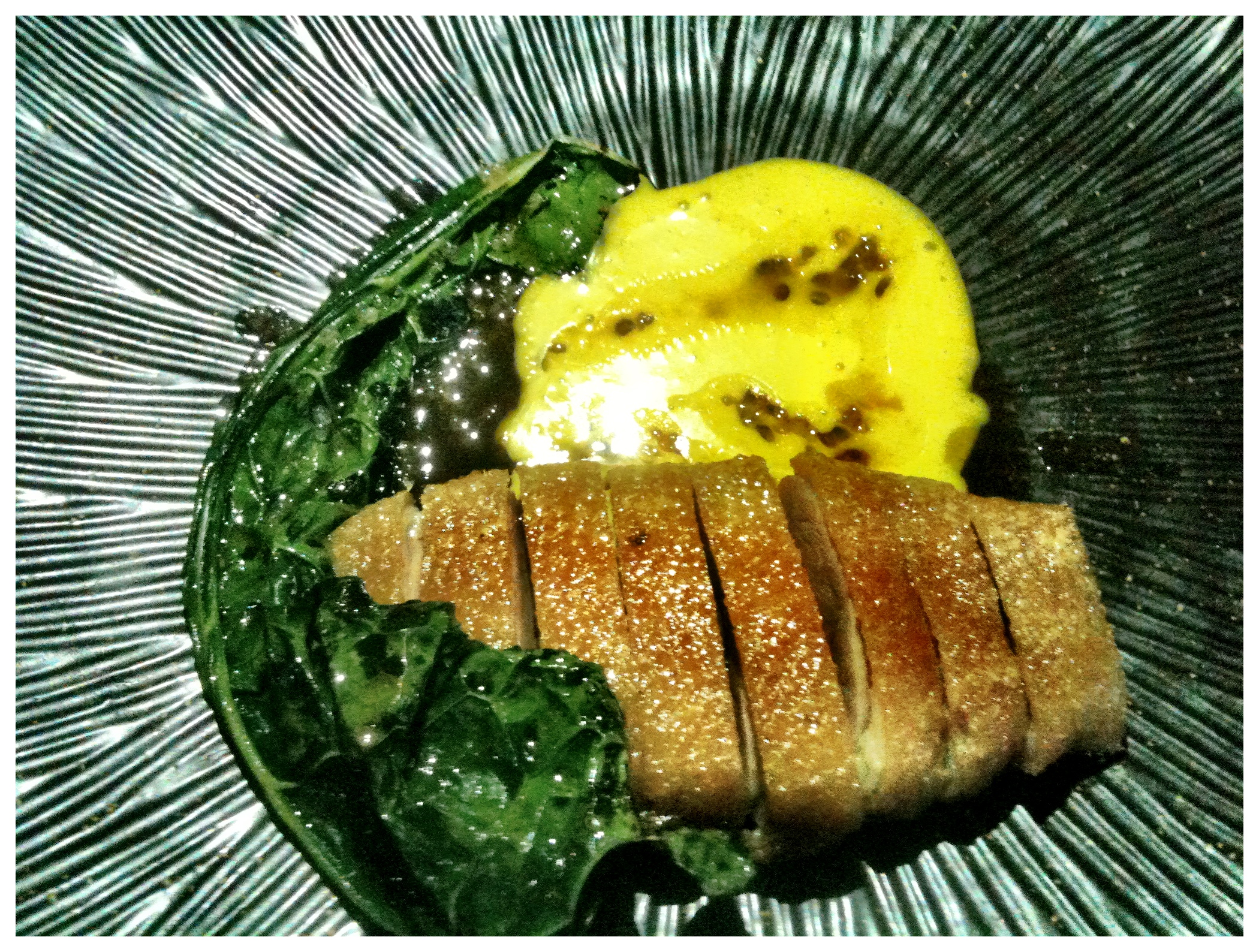
And my choice: grilled Blackmore’s tongue with wattleseed toffee (underneath the tongue) and coconut ice cream. The rich flavour of the tongue and tender texture matched with sweet. I was entranced by this dish.

Similarly rich and tender was my 3rd course, the Ranger’s Valley Beef Short Rib with beetroot and enoki mushrooms, and while it looks like I’m getting drunker and drunker from the poor quality of the photos, it’s that the light was fading and my iphone 3GS doesn’t have a flash (so we started using S.’s flash, and the photos, as you’ll see, become much better)

S. had a dish that was off the menu, and a special that night. Duck. How can you go wrong with duck?

Nice plate, huh? Oh, and we had a side dish of their famous potato chips cooked in duck fat. Suitably crispy.

The final and 4th course was dessert. We had a caramel pudding with yoghurt sorbet… and a milk chocolate cream cake with smoked banana ice cream and hazelnuts.

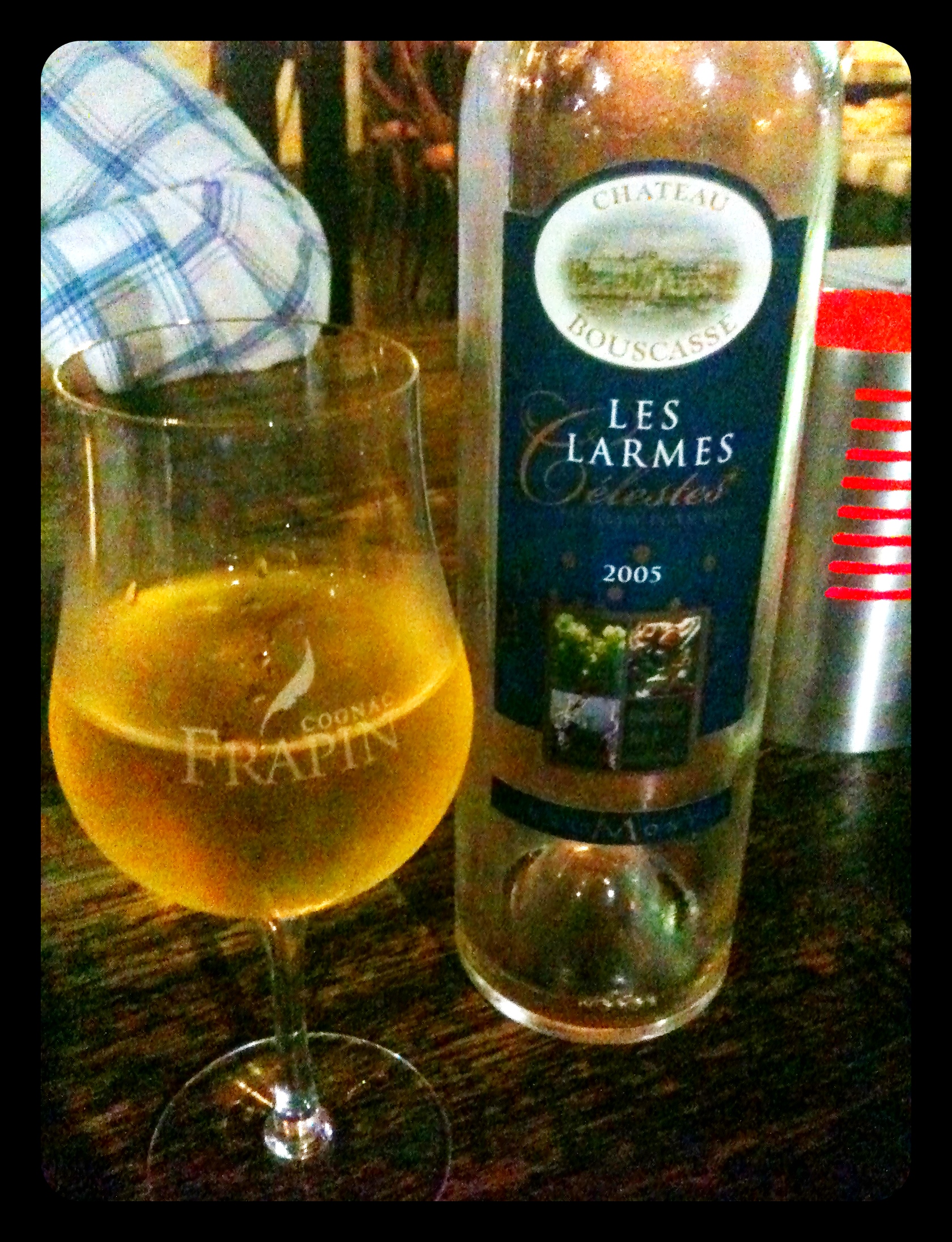
Oh, and to finish off, a glass of sticky: a french dessert wine called ‘celestial tears’.

One of the most exciting meals I’ve had lately. I can’t wait to try it again!

Posted in Food n' Grog | Leave a comment

Jane Birkin, Angel Place, Sydney 16 March 2012

Last night, I attended the strangest concert. Marvelous but unusual.

Jane Birkin is a French icon, the English daughter of a spy and an actress, who came to represent the cool swinging sixties. She landed a lead role in a French film (without speaking French), sang a duet in the film with one of France’s most celebrated songwriters, Serge Gainsbourg, and was eventually his partner for many years, and the subject of a number of his songs. She’s also the mother of Charlotte Gainsbourgh, also a singer and actress.

Dressed in a white shirt and black pants, her curls of hair flying in different directions over the evening, she sang a tribute to her partner who died in 1991. The style of the French chanson: ‘Chanson can be distinguished from the rest of French “pop” music by following the rhythms of French language, rather than those of English’ — so the mixture of spoken and sung, I remember hearing a bit of Gainsbourg’s gravelly delivery on some of his songs. Translated to Birkin, and Birkin of 65 years old, rather than in her youth, the vocal line would jump between pitch and off-pitch, make little swoops into a higher register, and sound as much like poetry and word-play than singing. Once I got used to it, I thought of it as an instrument until itself.

The highlight of the evening was the band! The orchestrations were clean and simple and melodic. The violinist (who turned out an amazing vocal performance at one point), a trumpet/trombone player, a drummer and an amazing jazz pianist created a beautiful backing to the songs. There was something so emotional about the piano playing, I was close to tears a few times. They are all famous Japanese musicians, apparently taking a year off to do this tour with Birkin (who told a rambly sort of tale about how it all happened in one night and somehow relates to the tsunami).

Oddly, Birkin gave the impression of either not being able to say or not knowing the names of her band members. She kept on thanking various members of her entourage by name, as well as Sydney contacts, but even during the musical number when she introduced the band, she seemed to simply shout the short form of their names just before their solos so it was impossible to get the names. It was clear, from her affection and respect for them, that of course she would know their names, but it did seem quite odd to refer to them so vaguely as her ‘Japanese’.

Just to balance out the error, I found their names on the net — and will be looking up their music, particularly the pianist:

Nobuyuki NAKAJIMA – piano
Hoshiko YAMANE – violin
Ichiro ONOE – drums
Takuma SAKAMOTO – horns

But anyways, back to the strangeness. I think the audience was mostly French. There was definitely a feeling of awe and respect from many quarters, and at the same time, Birkin seemed to deflect it; she seemed quite egoless, eccentric from being famous for so many years, but clearly seeing herself as an instrument for paying tribute to Gainsbourg’s songs. During one song, she moved through the aisles of the concert hall, disappeared, and then sang another third of the song from the balconies; her delivery had something both of a grande dame and the young ingenue that she was. I felt some distance from not being able to understand the songs, but there was also an informality that made it feel like a family concert. There was one standing ovation before the encore, another at the end, and a comical but sweet moment when she managed with great effort to tear apart the huge tightly-wrapped bouquet of flowers to give stalks of lilies to the band members.


Posted in Theatre/Concert Review | 2 Comments

Restaurant Review, Les Garagistes, Hobart

We planned to be in Hobart for New Year’s Eve and wanted to go somewhere special. S. had read and written down the name of Les Garagistes from an article that mentioned it’s one of Tetsuya’s favourite places to hang out in Tasmania. Being fans of his restaurant, we thought it was a good recommendation – so how lucky I felt to find on their website plans for a special meal to welcome in 2012. Apparently, we were the first to book!

We arrived for 7:30pm into a big cool dark grey space with a handful of long, high tables set up to the right, and a big open kitchen on the right (and at the back of the restaurant, some cured meats, hanging, lit beautifully and peaking through a window, as if artwork.)

Not having done my research, I was surprised to see that Les Garagistes is mainly a wine bar that serves fabulous food, rather than a more formal restaurant. Also: when we received the menu for the evening — mostly European wines (having travelled around tasting beautiful Tasmanian wines, we assumed it would be a Tasmanian-focused wine list). But of course: the restaurant is named after a movement of winemakers from the Bordeaux region, creative and rebellious, and going against the grain of age-old expectations.

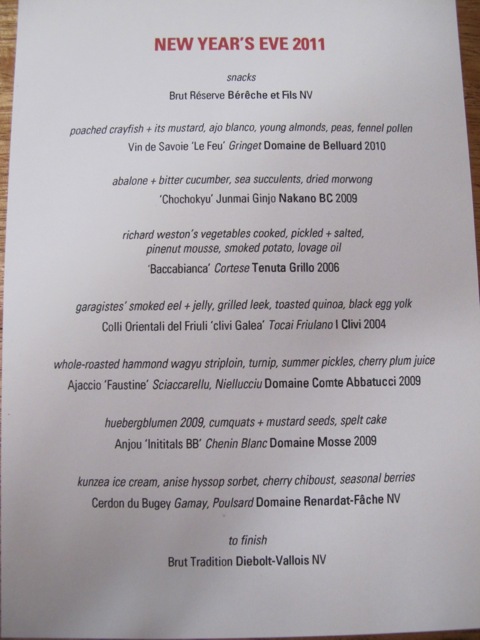
Hey, but imagine our excitement reading this menu (as we settled into a glass of Brut Reserve Bereche et Fils):

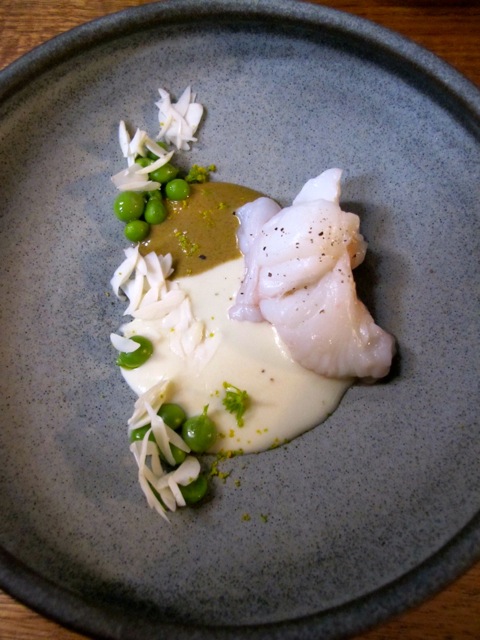
I think I was too excited to take photos of the ‘snacks’ (which I recall would have included some of those cured meats). But I was on track for the poached crayfish and its mustard, ajo blanco, young almonds, peas and fennel pollen.

Gorgeous! We loved the interplay of textures and the marriage of crayfish mustard to the thickened ajo blanco, typically a soup of almonds and garlic from Spain. The super-fresh crayfish. And the fennel pollen –interesting, I think there was pollen and hay and flowers snuck on to the plates on my last trip to Paris– was as much a gesture as a taste: your hands open in a field, dry and yellow from the hot sun. I thought the contrast of these two signals —ocean, field— was magic.

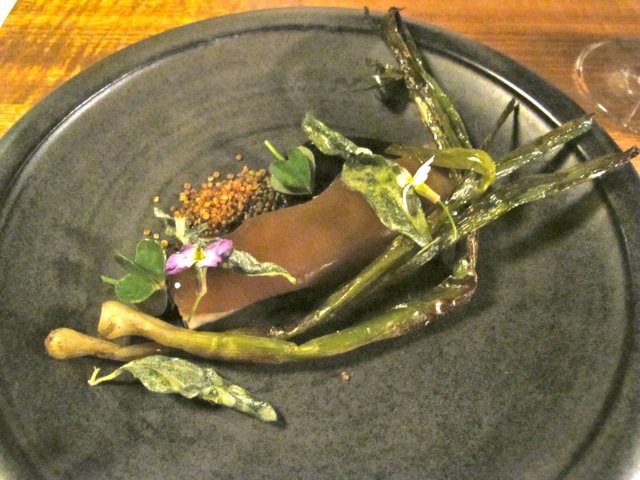
Love the simple dark stoneware. The plating was beautiful but also not fussy. This was really special. I know abalone from many Chinese banquets but it’s not something most Westerners have tried. I have no idea how they cooked them (usually, they’re stewed at banquets with whole shiitake mushrooms) but these thin slices maintained the best thing about abalone: a slightly chewy texture, tougher than a mushroom, say, but softer than a clam. It might not sound great, but it is. Matched with bitter cucumber, dried morwong (a fish) and sea succulents: whooooo. I’ve seen these sea succulents before, and I *think* I recall someone saying they’re edible, but had never tried them. So much innovation on one plate. And I love that it was served with a cold sake.

I missed getting a photo of ‘richard weston’s vegetables cooked, pickled & salted, pinenut moussse, smoked potato and lovage oil. The spark was in the taste more than the presentation of this dish (which I think was part of the fun, the discovery) – and I love that we learned the name of the Tasmanian producer who grew the vegetables! Instead, we skip ahead to ‘smoked eel and jelly, grilled leek, toasted quinoa, black egg yolk’. Pretty, huh? So, what were we learning about the food: unusual ingredients combined but leaving the food to speak for itself, and attention to texture with a crunch hidden somewhere in the dish.

Hugely entertaining during the evening was watching the team of chefs at work. I don’t think I’ve ever seen so open a kitchen before! The young folk all radiated concentration and care, they moved swiftly but were not rushed. The chef, Luke Burgess, was so low key, it was hard to pick out that he was in charge. They were organised and perhaps I’m projecting, but they looked like they love what they are doing.

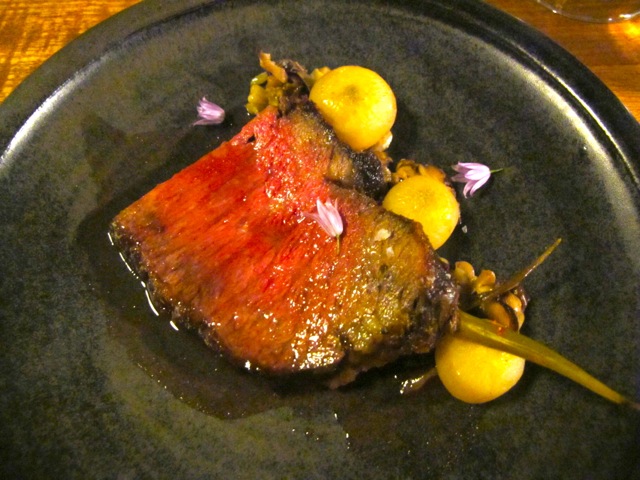
Case in point: the whole-roasted hammond wagyu striploin with turnip, summer pickles, and cherry plum juice. We watched the fellow in charge of it raise and lower the grill, and insert a thermometer in and out of various parts of the striploin many, many times. My brother, the meat broker, told me after it was likely to make sure that the meat didn’t get above a certain heat, at which point the amazing marbled fat would run out the meat and be lost.

We watched as he bound together some herbs, and chargrilled them, and then used them to baste oil on the striploin, raising, lowering, and finally into an oven to rest. It was like watching someone tending a baby!

I think I need to quote from the webpage where this meat came from: In the far NW corner of Tasmania, the Hammond family have been breeding Japanese Fullblood Wagyu cattle on their island property, Robbins Island, for the past 20 years. They run 5,000 Wagyu cattle in the operation … raised on isolated pastures with no supplements, hormones, or antibiotics – as naturally as possible, breathing the cleanest air in the world. The cool climate, salt air, and  pristine environment are ideal for raising some of the most tender and best tasting beef in the world.

So basically, S. and I think this was the best meat we have ever tasted. OHMIGOD.

I loved what appeared as a simple dish. A slice of cheese (huebergblumen 2009) –wow, it has a year– with cumquats and mustard seeds, spelt cake. Perfect (and a nice light course to follow that heavenly striploin).

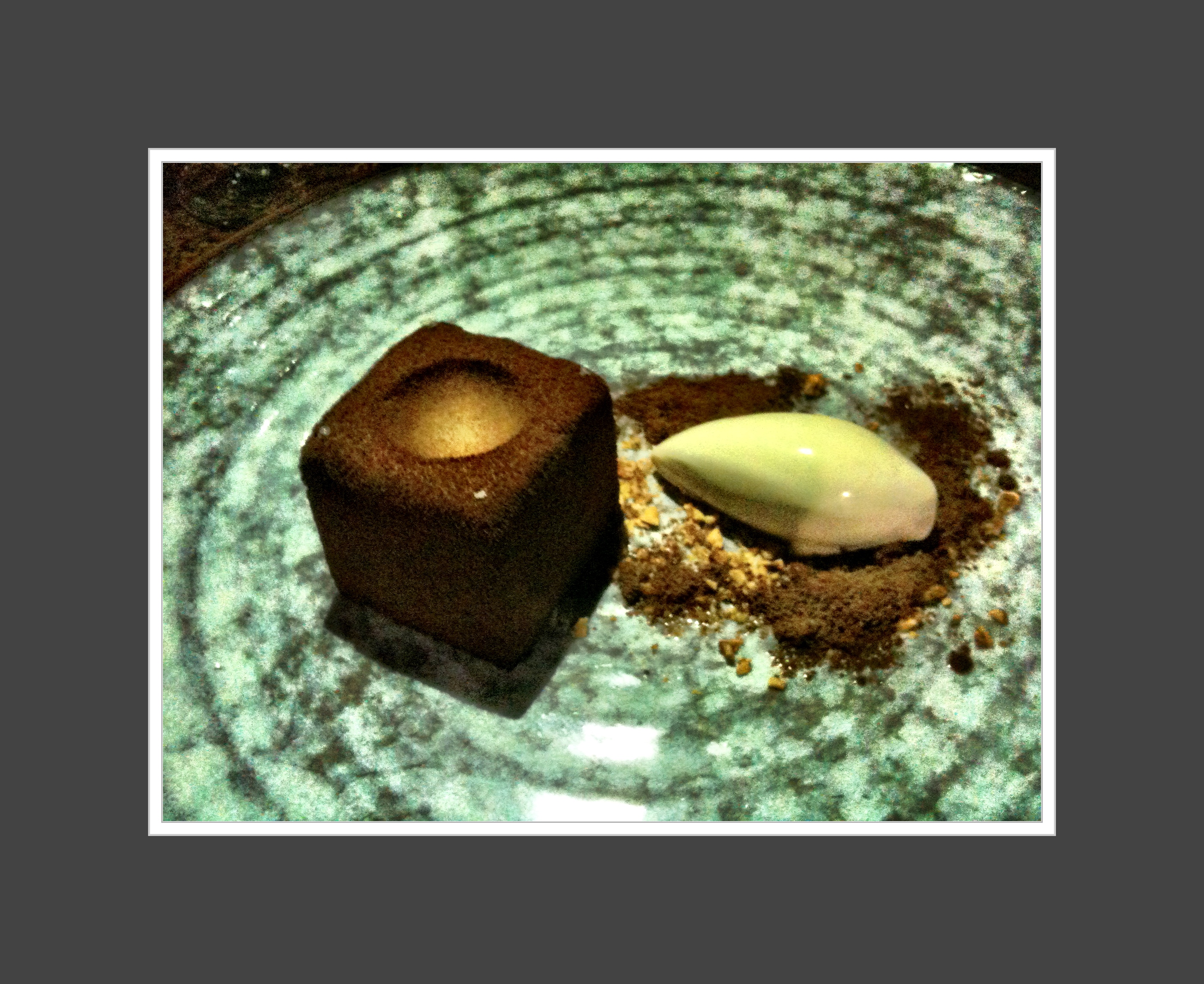
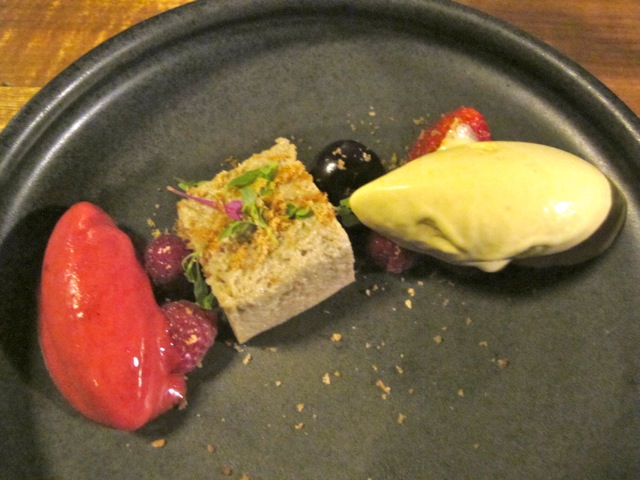
This was kunzea ice cream, anise hyssop sorbet, cherry chiboust and seasonal berries. We looked up kunzea too, a native myrtle tree. And then, not even on the menu, an extra final course:

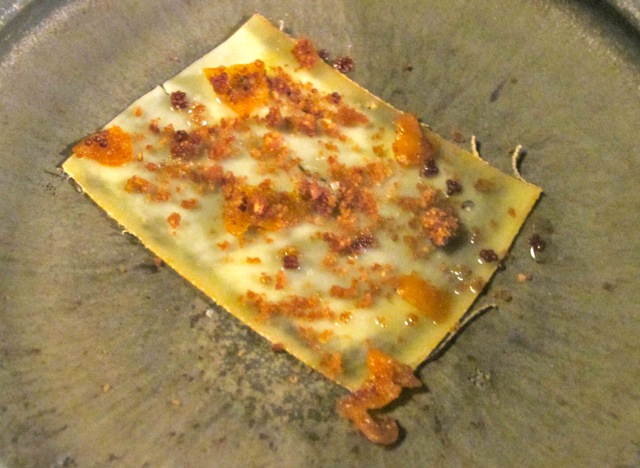
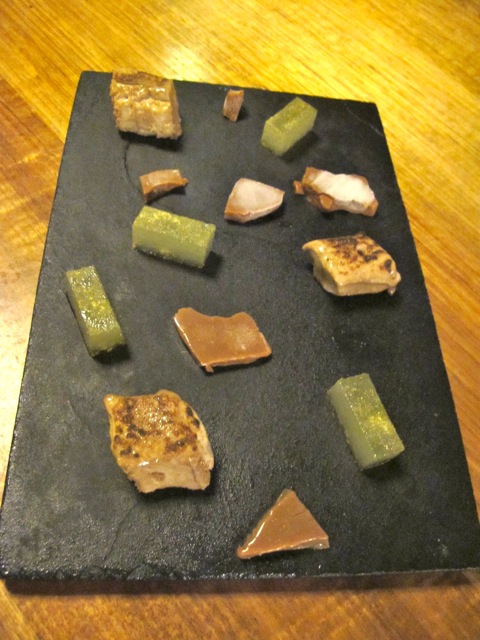
A green jelly, a marshmallowy sort of thing, cheese? I am by this time in such food heaven (and wine, which I haven’t mentioned but which were uniformly interesting and tasty) that though I managed to take a photo, I look back, and can’t remember much except that I liked it. The meal finished with yet more champagne (Brut Tradition Diebolt-Vallois).

We had no idea that we were being served by one of the owners, Katrina Birchmeier (the third partner, Kirk Richardson, was serving another part of the room), until we asked who was responsible. But beforehand, S. had pointed to her as she leaned over the counter (on tip-toes, as she’s not tall): ‘She’s on top of everything, knows her stuff, and is super-efficient’. Great, personable service: what a privilege to be able to ask her about the wine and food.

You’ll know already that my verdict is good, but I’ll go a step beyond. I’ve made it a point in the last years to eat at a lot of fine restaurants and this combines the best of what’s out there: the emphasis on food rather than formality with locally sourced produce served without fuss but with such innovation and care and knowledge that the diners are the ones that can make the fuss. It was one of the best meals I’ve ever had. And we even finished in time to run down the hill and see the New Year’s Eve Fireworks.


Posted in Food n' Grog | 2 Comments

Books I read in 2011

With a comment or two, if I felt so inclined.

  • Mary Oliver’s New and Selected Poems Volume 2 (Poetry) – some gems, and better in small doses, I was surprised that I wasn’t taken by the work of this celebrated poet.
  • John Rock’s Paseando: Out for a walk (Autobiography) – an interesting and engaging book by a friend – travel tales and more
  • Richard Labonte’s Beautiful Boys (Gay Erotica/Anthology) – I thought this was a good, digestable mix of stories – some more traditional erotica, others less so.
  • Michael Cunningham’s By Nightfall (Fiction) – I’ve read everything that he’s written and I’m not stopping now. Many moments of beauty, but I wasn’t as engaged as previous books.
  • Larissa Lai’s Automaton Biographies (Poetry)
  • Tim Winton’s Cloudstreet (Fiction) – This is Australia, it’s language, it’s heart and bones. They should have made me read this when I landed in Sydney.
  • Carol Shields’s The Stone Diaries (Fiction) – Again. I started it and realized I’d read it before.
  • Adam Gopnik’s Paris to the Moon (Memoir)
  • Alice Munro’s Too Much Happiness (Short Fiction)
  • Charles Merewether’s Ai Weiwei: Under Construction (Art Criticism/Review)
  • Best American Poetry 2011 (Poetry)
  • Dave Eggers’s Short Short Fiction (Fiction)
  • Tim Miller’s Shirts & Skin (Autobiography/Gay)
  • Joanne Harris’s Coastliners (Fiction)
  • Tina Fey’s Bossypants (Autobiography/Comedy)
  • Patrick Gale’s Rough Music (Fiction)
  • E.B. White’s Charlotte’s Web (Fiction/Children’s)
  • Jennifer Egan’s Welcome to the Goon Squad (Fiction) – my pick for the year. Great writing, great story-telling, of-the-moment, funny, touching. The whole gamut. Loved it.
  • Alan Downs’s The Velvet Rage (Psychology) – essential reading for gay men. If it doesn’t help you understand yourself, you’ll recognise your friends!
  • Charlotte Brontë’s Jane Eyre (Fiction) – As a first foray into trying to read a book on an iphone, this was a good choice – with a linear narrative. Always wondered what the fuss was about, and now I know: really beautiful use of language. Jane is a pretty fabulous character too, though I think I really understood her after seeing this year’s film version (which was great).
  • Margaret Atwood’s Year of the Flood (Fiction) – I love that Atwood did a companion novel set at the same time as Oryx and Crake but from a completely different perspective. Inventive, readable, poetic and engaging. That’s how I like ’em.
  • Dan Disney’s and then when the (Poetry)
  • Chandler Burr’s The Emperor of Scent (Biography/Science) – Review on my blog.
  • Michael Chabon’s Gentlemen of the Road (Fiction) – Review on my blog.
  • Ian McEwan’s Company of Strangers (Fiction)
  • Anita Desai’s The Zigzag Way (Fiction) – Review on my blog.
  • Anne Tyler’s Back When We Were Grownups (Fiction) – I traded in a stack of books at Elizabeth’s used book store, and used them to buy the Burr, Chabon, McEwan, Desai and Tyler… I’d say the Burr was the most engaging! What next, what next?
  • Gail Anderson-Dargatz’s A Recipe for Bees (Fiction) – a Canadian novelist who had a hit with her first book. I found this engaging and quite lovely – and enjoyed the older narrator. I’m a bit tired of the trope of the curmudgeonly, cute and cuddly older narrator (i.e. I did love the story of Water for Elephants, but found the narrator a bit much) and found this speaker much richer and more interesting.
  • Dr. Raymond Moody’s Glimpses of Eternity (Spirituality) – a follow-on to his book about near-death experiences, this one is about shared-death experiences. I’m open to what he presents though didn’t love the way he presented it.
  • Michael Ondaatje’s The Cat’s Table (Fiction) – I finished the first half in the last days of 2011…

Feel free to share in comments your favourite book of 2011.

Posted in Book Review, Books | 2 Comments