Sydney Food Adventures: PorkStar dinner at Assiette, July 2011

So, I got an e-mail notice of the offer of:

Porkstar 6 dish degustation menu with matching wines from Yarraloch wines at Assiette restaurant.

Well, that’s a no-brainer.

1. I love pork

2. Assiette restaurant is wonderful and only a few blocks away

3. The Entertainment deal said that it would be $110 instead of $160, which for a tasting menu with wine, I think, is a mighty fine price. I love a bargain.

So, come dine with me!

We headed down on 6 July 2011, a Monday night, and sat down to this menu…

PorkStar1

Yum, what fun! Here’s a little tour.

I missed taking a photo of the cabbage soup… but the next course was the salad of boudin noir, guanciale, crispy quail egg and peas. How pretty is that.

PorkStar2

And then we have the Indian Spiced Pork Belly with seared scallop, onion bhaji and mango chutney puree.

PorkStar3

I liked how the Indian flavours were married to something so upscale – I think of onion bhaji as a cheap, greasy snack.

Love the “leaves” of… I think it was cauliflower.

The next course, the crispy skin mulloway and szechuan pork cheek… well, I think it must have looked so delicious that I lost my concentration and didn’t take a photo. The pork cheek was so tender and melt-in-your-mouth. The mulloway was a nice match for it.

And next, is the roasted pork fillet with Jerusalem artichoke, croustillant and dates and fennel salt. And again a leaf of cauliflower, or was it fennel. Hmm, can’t remember. It was different than the first leaf, so I’d say fennel. Tasty.

PorkStar4

And finally, a citrus terrine with passionfruit ice cream and poached rhubard. No pork. But still beautiful.

PorkStar5

All in all, a wonderful meal. Great textures, flavours, matching wines and… pork. I was surprised that there was a table or two empty but the waitress said that the next night was fully booked (it ran over two nights).

As my friend Davy said this week: Pork Belly is a Human Right.

Thanks for dining with me!


Posted in Food n' Grog, Sydney | Leave a comment

Book Review: My Stroke of Insight

Many people are familiar with the TED (Technology Entertainment Design) talk given my Jill Bolte Taylor – a brain scientist who experienced a massive stroke in 1996. What made her experience unique was not only that she was experiencing what she had studied, and later came to be able to describe it from personal experience in a way that no one has done. It was that her findings were completely unexpected. She was a scientist and academic, much of her life located in the left brain of rationality. With damage to her left brain, she suddenly found herself in the peaceful world of her right brain.

Jbt

If you haven’t checked out the talk, it is amazing. Find it here. It’s an incredible story which she makes entertaining and educational, and parts of it are just so beautiful – when she’s describing her experience of her right brain, I almost felt like I was watching great theatre like “Angels in America.”

If that peaks your interest, the book is a terrific way to go from the bite-size twenty minute talk to a much fuller story. What I’d never seen done before is to combine the worlds of rationality and spirituality so well. We can read anywhere about how we need to live in the present, how we need to consider human kind as one, and as one consciousness. More complex messages are about stopping viewing the world in dualities and about moving beyond the personalities and patterns that we’ve developed.

What Bolte-Taylor offers is a synthesis. The left brain is responsible for rational thought, for setting boundaries, for individuation, for time. It is a marvelous instrument, a miracle. But the right brain, much suppressed, is able to see the world and humanity as one, borders disappear. The sides of the brains are not opposed but are part of a whole. What she encourages is that we step to the right to make a more loving and peaceful world. That sounds trite, written alone there, without the book behind it, “loving and peaceful world” – but when placed in the context of how she describes how the human brain works, it is indeed a stroke of insight.

_wsb_183x276_Paperback.jpg

What also comes clear in her writing is her sense of purpose: before the stroke, to help humanity by understanding the brain better; and after, with the personal experience of a stroke, to provide better care and treatment for those who have had strokes, to better understand mental illness, and to accept the elasticity of the brain. I also found it fascinating to read her account of her recovery from her stroke, and how she found she had the choice about which parts of her personality to recover. She chose not to take back anger and anxiety. She provides a really clear description of the way that our personalities and identities are built, and that it is not necessarily a given. Our brains can be rewired, our identity is fixed as a story through our left brain, but we could choose to be without identity, to be consciousness. How often have you heard someone say, “well, I’m like that. I can’t help it.” Or people who tell so many stories about their stories and histories that they somehow miss participating in the world around them?

It’s one of those books that I wish everyone would read – and I was musing that it would be a useful book for skeptics of spirituality. But reading other book reviews on amazon.com and the like, I see that some readers are unconvinced by her arguments – they accept her ‘scientific’ descriptions, but travel no further into accepting how the right brain works and what it can offer humankind. Ah well. I suppose I was being too hopeful.

Anyways, my recommendation is that if you find a copy somewhere, grab it! She also has a website.


Posted in Book Review, Spirituality | Leave a comment

Book Review: The Slap

slap-novel-christos-tsiolkas-paperback-cover-art.jpg

I heard the buzz about this book. It was making the rounds of all my friends and the reviews were positive. So, it was a good push for me to give Tsiolkas another try, I’d read “Jesus Man” and found it a hard go, the writing voice itself didn’t resonate with me, and the exploration of the darkness of the narrator also repelled. I don’t need fiction to be sweetness and light, but I’m more drawn to hope than despair.

With that in mind, I’m bowled over by “The Slap”. The darkness is there, characters that hate and have violent thoughts and want to annihilate themselves and others, but they’re balanced by other wavelengths, sometimes in the same people. I found the eight main characters who tell this story believable and interesting, and a compelling look on the whole at the society they make up. I’ve met these folks in Australia, read about them and see them on TV but I’m not sure I’ve read about them, deeply imagined, conflicted, human, Tsiolkas inhabits his characters so that readers have the opportunity to move beyond judgement – though it sounds like that is one of the things that is making this novel so exciting is how readers are taking sides, of the characters and on the book.

I wanted to get back to the story as soon as it put down, a page-turner in the best sense, not driven by a formula for suspense but a real interest in where the story will go, who gets to tell it to us, and what happens next. Tsiolkas is not a writer whose prose I particularly notice, I don’t get caught noticing a particular turn of phrase, but the way that he describes his characters, their lives, and drives the story along: I thought it was magnificent. And as hinted above, I like a happy ending – and the novel’s end, with both its resolution and happy possibility, made me smile, top to toe.

I’m looking forward to the TV series adaptation!

[Thanks to Chris for my copy!]

Posted in Book Review | Leave a comment

Book Review: Mary Oliver, New and Selected Poems, Volume Two


new-selected-poems-volume-two-mary-oliver-paperback-cover-art.jpg

For someone who has written two books of poetry, I am, perhaps, not as regular a reader of poetry as I should be. I do not keep track of the many vibrant internet publications, nor read literary journals regularly. Because I want to support my fellow poets, I end up buying (or sometimes trading) books at readings and events, and reading local poets and new books by friends and acquaintances. Sometimes this is less than rewarding, wanting to like the work, but discovering that even though I find the writers amiable and engaging in person, I don’t quite click with their writing. Though sometimes I do, which is a joy.

I have found that when I read good poetry, and poetry that I connect with, that it often sparks a poetic impulse in me, much more so than the connection between reading prose and writing my own. So, I’ve made it a habit to occasionally buy favourite poets, as well as new ones. This I tend to do whenever I am visiting my family in Hawaii, or on occasional trips to another part of the USA. The American book market is so huge that even in bookstores with vastly reduced poetry sections, there are still interesting books and they are not expensive (unlike in Australia).

By now, I think I’ve bought all of Sharon Olds’ collections, as well as Mark Doty’s (two of my clear favourites), and have a few volumes of James Merrill and Gerald Stern. If in Canada, I make sure I’ve got whatever John Barton has published lately, perhaps Lorna Crozier or Patrick Lane, or as afore-mentioned, poets I’ve met. I usually buy the Best American Poetry series, which I love for allowing the poets to talk about the poems that were selected; and feel neglectful that I have not read one of the two Best Australian Poem anthologies that are published yearly (it surprises me that the Australian market can support two competing anthologies, but I’ll have to explore that further).

On a trip to Hawaii in December 2010, I decided to get to know Mary Oliver. A number of months beforehand, at a ‘5 rhythms’-inspired dance meditation session at the university, the facilitator had closed our two hours with an Oliver poem. It was beautiful: simple and lyrical, evoking the natural world and asking of our place in it. I made a mental note to look her up. And here, at Borders, at an extremely disappointingly reduced poetry section (not even a few shelves) were a few of her books, included two of selected poems. I like ‘Selected Poems’ for the range of work that they offer, and the way they provide introduction and overview. I chose the second Volume, as it includes 42 new poems, as well as 69 older poems chosen from 6 of her 8 last books. I was intrigued by the cover notes announcing that she has won a Pulitzer Prize and National Book Award and is according to the New York Times, “Far and Away, the country’s best-selling poet”.

Right away, I recognised the voice that I’d been introduced to earlier this year. In ‘Mysteries, Four of the Simple Ones’, she addresses the seed-grain, the catbird, the turtle and blue heron in turn, then ties the natural world, her preferred subject, to the act of observing and writing poetry (‘to pluck from the basket the brisk words/ that will applaud them’). I find the form of the poem perfect. The seed-grain gets a short question, and longer questions go to the three animals, she steps into the poem to make a simple summation and celebration, addresses the animals once more by name, and gives the final word to the seed-grain, as if the initial question asked (‘How does the seed-grain feel/ when it is just beginning to be wheat?’) had been suspended in the reader’s unconscious to be completed by the final image of the seed-grain ‘kneeling in the dark earth, its body/ opening into the golden world?’

I was also struck by her openness, her simplicity, and the declarative quality of her words. ‘Today again I am hardly myself./ It happens over and over.’ she explains in “Reckless Poem”. Describing a period of teaching in Indiana, she asks ‘You tell me if it was worth it.’  It reminded me of the collection of Rumi’s work that I read last last year. Simplicity, emotion, and a direct address to the reader. Completely unfamiliar with Rumi, I felt it important to be open to his voice (or the translation of his voice), from a different time and place, in such a different style than other poets I know. I wanted to take him on his own terms and I was charmed (as well as finally understanding why so many people have referenced Rumi over the years.)

In the same way, I wanted to be open to Oliver’s unique voice. But I feel self-conscious to discover that I didn’t love this collection over all. How could I not enjoy such a popular, well-read and celebrated poet? I tired of poem after poem, personifying nature and animals. I found the sentiment veered towards mawkishness (usually avoiding it but teetering on the edge). And while I welcome her celebration of life, I have the feeling that I’d enjoy the poems read individually and occasionally, to remind me of the beauty of silence and nature–instead of, for example, seven poems in a row in the book where she make odes to silence while freshening flowers, then speaks of the virtue of beans, encounters with animals in Indiana, snow crickets and lilies, the natural world, and snow geese with words like delicious, wonderful, good, fancy, happy, lovely and joyfully – I found a sameness in tone and theme, broken sometimes with a tougher vision that appealed to me more: ‘sing of the perfect, stone-hard beauty of everything.’


Posted in Book Review | Leave a comment

Book Review: Kyung Ran Jo’s Tongue

tongue-novel-kyung-ran-jo-hardcover-cover-art.jpg

“Tongue” is Kyung Ran Jo’s first novel to be translated into English, but she’s the author of four short story collections, another novel and a collection of essays. The scuttlebutt on the book is that the author was a judge of a writing contest. A novella with similar writing and the same story was submitted by a woman, Ju Yi-ran, who claims that it was stolen from her for the writing of Tongue. She’s now published the novella, in its own right, with a cover that says something like “the book that Jo stole from”.


For me, the novel would have been much better as a novella: a barer plot, the interesting descriptions of food and cooking and eating to move it along, and the more dramatic incidents not dwelled upon. More of a modern folktale than a novel, and where individual chapters don’t feel as weak.


I can see the book’s appeal. It’s a book for foodies, and the descriptions of a young woman chef, the restaurant she works in, and the dishes she creates and cooks, are fantastic. It’s interwoven with folkloric anecdotes – Mitterand’s taste for the endangered ortolan, Roman women who baked cakes in the shapes of their intimate parts, how to smuggle foie gras. And yet, it’s a fine line between poetry and nonsense: “Love shatters with the rumbling of thunder, but thunder causes truffles to grow”; “the taste of love encompasses the wilted, the overly ripened, the rotten, and the bitter.” I think it will really depend on the reader how much they love the style and language of these food-related passages.


I had problems with both the narrator and the plot. The book is basically a gothic horror story, so I shouldn’t demand realism from it. But it was hard for me to become emotionally involved. At the same time, I DO find some fairy tales emotional, even though they are fantastical. At some deep level, they make sense to me.


But this story doesn’t make sense to me at all. Is it cultural? Gender-related? I’m not sure. The narrator, told over and again, that her relationship is over by her ex-partner, still wants to be with him. He sounds like an arse. There’s no compelling reason for her to love him. At this stage in my life, I don’t find unrequitted love romantic. I understand the pain of break-up, and the pull of inappropriate relationships, but a whole book with no emotional progress or growth? Nope.


Meanwhile, when she first catches him in bed with his new lover, instead of confronting them, she stays silently by the door, watching and then describing to us the scene in full detail. This seemed ridiculous to me. The woman who he leaves her for forces the narrator to be their personal chef at the restaurant (and yet we only read of this about to happen, but none of the action or outcome). Then the same woman kills her partner’s dog with a frying pan. The narrator’s supposed best friend does a special feature on the ex and his partner in her magazine. Every possible betrayal, every possible cruelty is crammed into this story. Earlier in the book, it is recounted that the narrator’s uncle wife commits suicide by hanging herself, but not before covering her naked body with oil. Does that image impress or appeal to anyone?


I guess that not being a fan of the horror genre, this book wasn’t for me, but I picked it up because of my love of food. But chapter after chapter of cruelty, misery and pain… the “shocking” ending just felt distasteful to me… and gave me the feeling that the whole book had been constructed to lead up to it. A disappointing read… and literary feed.

Posted in Book Review | 1 Comment

A book about me.

I admit to being an ego-surfer, which started somewhere around the time of my first books being published. So, at least I could have an excuse for entering “Andy Quan” into google to see how many hits came up, and where my name appears on the Internet. But it’s not really an excuse, more of a silly exercise in self-regard.

Still, old habits die hard, and I’ve kept a “google alert” for my name, which occasionally sends me something interesting – if someone has mentioned one of my books in a blog, etc.

The other day, I got the strangest alert yet. A company called “Alphascript Publishing” has copied information from my wikipedia page and made it into 84 page book which they are charging 34 Euros for. Wow, a book about me.

Now, as an aside, wikipedia is an interesting enough phenomenon on its own. When I tried to put up an entry for myself many years ago to help publicize those first books, I was immediately identified, through my e-mail address, as the author of my own entry, and was rejected! A friend put up a basic one for me later… but then someone, I’m not sure (a fan?), used information from my website to expand the entry. So, for the last many years (because I was perplexed at how to change it), my entry talked about my interest in amateur wrestling… which was a short phase in my early years in Sydney and not the pastime that I wanted to be globally recognised for.

While I finally changed the wikipedia entry (sigh, by creating a false e-mail address with which to edit it), information in cyberspace doesn’t go away. So, my new biography includes the wrestling information on the publicity for the book.

Doing a little websearch, however, I find it’s a very bizarre scam. The company creates tens of thousands of fake books, at no cost. It’s a computer program that compiles it, and then sends the information out to booksellers. I imagine it’s print on demand, so that if someone actually orders a copy, it is printed on the spot and sent out. While it’s 100% unlikely that someone is going to order my unauthorized biography, it does seem to trap people with specialized interests who are so excited to find an actual book on Ancient Egypt and “The Battle of Verrieres Ridge” that they order the books, and receive computer-generated gobbledy-gook. It doesn’t seem to be illegal though – as wikipedia information is in the public domain – and it does say on the book cover “this information is primarily from wikipedia sources”.

A great blog entry by Chris Rand about the whole Scam Phenomenon here who also points out that there’s a wikipedia page about the scam as well, which “might be ironic if they make that into a book.” Heh.

Posted in Blogging, Writing | Leave a comment

Book Review: Best American Poetry 2010

I’ve always enjoyed the Best American Poetry series – I’m pretty sure my friend, journalist John Reed, turned me onto them when I lived in Brussels in the mid-90s. Since then, I’ve inconsistently picked them up, but when I have, I appreciate the job that the guest editor does (this year was Amy Gerstler) of sifting through thousands of poems, in journals, books and online, and choosing a ‘best selection’. Some years, I am more excited, others more challenged; I’m not sure what kind of objectivity I bring to the process since I’m probably also affected by the particular mood that I’m in the season I read it. What I’ve consistently enjoyed is reading the biographies of the poets, and their statements about the poems that have been chosen. Some poets choose not to comment, some give a face value response, others are more poetically allusive.

cvr9781439181478_9781439181478.jpg

I liked this year’s collection. A few perhaps I was less engaged with, or didn’t understand, but nothing to make me notice. More near the end of the collection did a few poems make me stop completely, and make note of how much I liked them, for example, Carl Philips’ “Heaven and Earth” and G.C. Waldrep’s “Their Faces Shall Be as Flames”. But there were certainly others that I enjoyed. I enjoyed the contrast between the economy of a poem like Todd Boss’ “My Dog Has No Nose” and a prose poem such as by Thomas Sayers Ellis – I’m often not so engaged by prose poetry, but this treatise, “Presidential Blackness”, is fantastic, for some reason I was reminded by this of some of the passages from Angels in America.

I like trying to make some sense out of the whole. Nearly everyone in the anthology is a university or college professor, though there is a musician, a caterer, and a fine arts consultant and researcher. Most poets I’d say are in their early forties, a few in their thirties, and many older, established writers. It was good to read poets I’m familiar with – Sharon Olds, Charles Simic, Louise Glück, Gerald Stern – and be introduced to others. There seemed to be a lot of sonnets, but also many poets working with traditional forms and metres. I think Corinne Lee’s selection might have been the only poem I’d consider experimental. Most poems were very accessible. I find it quite exciting to read criticism like that of Anis Shivani who in his dissection of the 2009 anthology has enough knowledge of contemporary poetry and a clear viewpoint on what good poetry should be to offer meaty commentary on what he reads. Me, I’m a much more casual reader, and lesser informed. In that way, I don’t necessarily read the BAP series to be able to offer critique, but just to catch up on what’s happening. For someone who writes poetry, even if it’s not the style of poetry he or she writes, I think it’s a good thing to do.

Posted in Book Review, Poetry | Leave a comment

Restaurant Review: Orto, Sydney

(April 2011 review; now, they’re only open for breakfast and lunch…):

Run, don’t walk, to Surry Hills’ latest new restaurant, Orto, but make a reservation first. We were there on the 3rd night it opened, a Thursday, and sat at the bar, since the tables were booked up. The women who brought the stylish, upmarket café Baffi and Mo to Redfern Street (which, I’ve heard reported, has sadly declined in their absence) went travelling in Europe and came back to open this new modern Australian restaurant, at the corner of Waterloo and Adelaide Street, on the ground floor of the deNode, next to the Reader’s Digest Building.

‘Orto’ (the full name of the restaurant is Orto Trading Co.) means ‘garden’ in Italian, and that’s the decorative theme here, a cart of fresh, potted herbs out front, flowers and leaves suspended from bottles above the bar. There are beautiful wood tables and quite a few large ones for big groups – or is this a mini-version of the table-sharing at other restaurants. Our spot at the bar had a comfortable view of a skilled bartender, whipping up inviting cocktails, and a popcorn machine, talking to itself while providing the basis for the complimentary tiny metal bucket of truffled popcorn.

The menu is uniformly interesting – I could have ordered any one of the dishes. What we decided on was “Toad in the Hole“, a perfectly baked Yorkshire Pudding (I’m not sure I’ve ever had a Yorkshire Pudding here in Sydney) with a homemade sausage in the middle; and a Scotch Egg. I came to know (and love) these treats in London, but the ones in delis and groceries have a hard-boiled egg – to have a gourmet version with homemade sausage surrounding a soft-boiled egg was fun. They were both beautifully done and inventive.

For the mains, pork shoulder for S., huge pieces of pork with the fat left on (which he gave to me!), the meat was delicious with more of a ham texture than what I’d expected. It was super tasty, served on a wooden cutting board, with roasted brussels sprouts, toasted hazelnuts, and I think a butternut pumpkin mash. I ordered the cabbage roll – which had the same rustic, homemade feel which I hoped for – but was elevated to gourmet status with wild mushrooms, barley and goat’s cheese, and a homemade tomato sauce/stew on the side.

I wish I’d brought my camera, but I’ll be back, and will document the next meal… it was too dark for my iphone.

What really thrilled me was the vibe. It’s clear to me that the owners were in charge of every detail of the restaurant, and hired all of the young, good-looking staff, and have filled it, already, with love and personality. The owners were greeting friends who were stopping by; it felt like their friends were excited about being able to eat with them again. Our neighbours at the bar leaned over to rave about their dishes and enquire after ours. The owner knew exactly when to take our order and bring our bill; it was busy but she provided us with top service. Compare that to Cotton Duck, a block away, always packed and with great reviews. But on the 2nd night that the Duck opened, there was an air of confusion, and even with a full complement of staff (and not too many tables), our food took so long to get to us, that I don’t remember whether it was any good. I’ve been trying to convince myself to give it a second chance, but with Orto and its enticing menu, I’ll be heading back there first.

Orto Trading Co.
38 Waterloo Street
Reservations: dine@ortotradingco.com.au
Phone: 0431 212 453
 

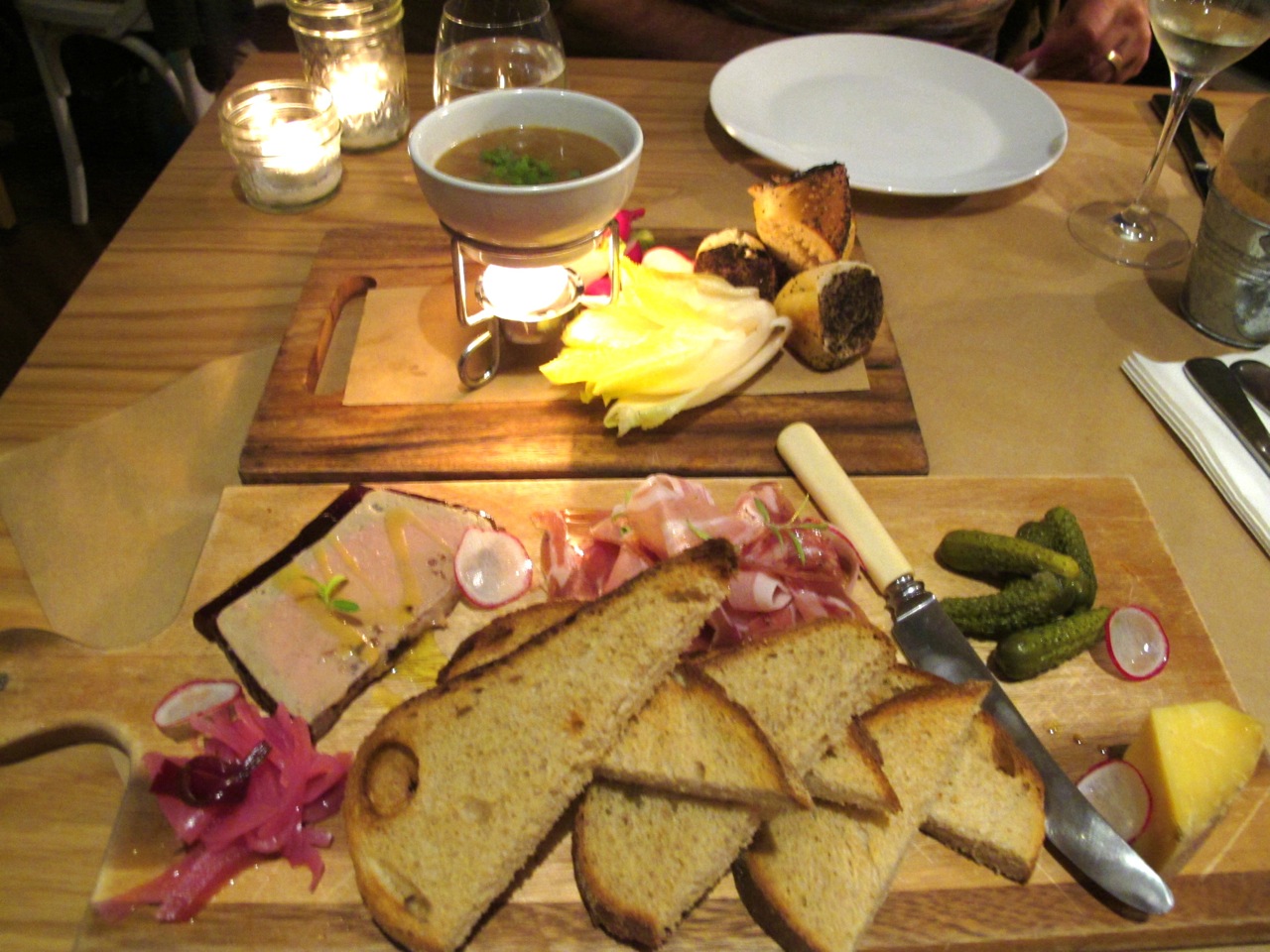
(August 2011) And here’s my update… My partner went again for a birthday party and said the food was even better than the first time. This encouraged me to go in mid-August. I still forgot my camera. The jug of Pimms was awesome – and the food was as exciting as I remembered it. I went again last night with two friends (23 Aug 2011), and between the 3 of us, we split two appetizers – a kind of cheese and meat board (at the bottom of the photo) and a fondue of Welsh Rarebit (at the top):

I really liked the rich flavour of the rarebit, and the choice of endive leaves, radish and poppy seed bagels, to dip into it. A fun, unusual plate. The other dish was a perfect combination of meat, cheese, pickles, onion and the superstar of the dish, a creamy and beautiful liver parfait.

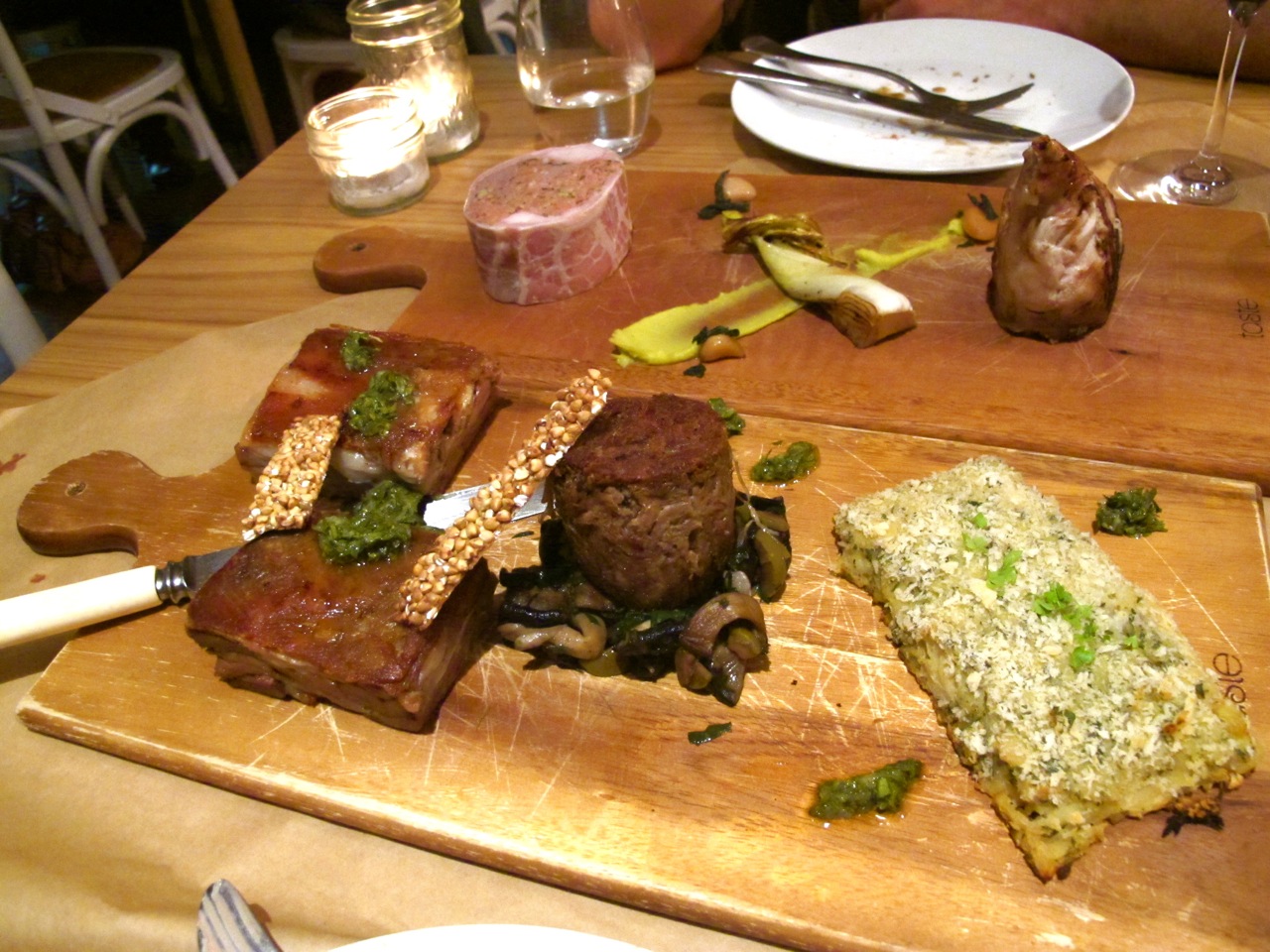
For the mains, we shared two between us. A stuffed rabbit leg, with a rabbit terrine – generous portions – quite ‘meaty’ and filling. And then the amazing lamb belly dish, with two squares and one round of lamb, a tasty starch (I don’t remember what it was – parsnip?), buckwheat cracker sticks and mushrooms

I just don’t know of any other restaurant that it serving food in this style. There are dozens of restaurants who explain “our plates are made for sharing” who serve tiny round tapas plates. No, these plates really are for sharing – substantial, tasty, innovative, filling… and what’s that description they were always trotting out on Masterchef this season? –honest. This food is honest.

And the damages? Two generous entrees, two generous mains, and two bottles of wine between three of us: $80 each. Compare that to another Italian eatery that I was at this week – one appetizer, one not particularly large main, and a half a bottle of wine: $70. I know which place is the better deal. Orto, I’m a huge fan! Keep up the good work.

Click to add a blog post for Orto Trading Co. on Zomato

Posted in Food n' Grog, Sydney | Leave a comment

Paris Food Adventures, Day 3: Le Chateaubriand

3 days, 6 memorable meals later (not to mention some good pastries and coffee for breakfast). I finished with a bang on Thursday night, 17 March 2011.

The original inspiration for my culinary adventure was an article in the New York Times about hot, new young chefs serving prix-fixe menus, mainly in bistros. Apparently, modern haute cuisine that is affordable is sometimes referred to as bistronomy, sophisticated food, that unlike some of Paris’ top restaurants, won’t cost the equivalent of a week’s rent in Sydney! Even on my return from Paris, the NYT was still talking about the Chateaubriand in “A Paris Farewell”.

Located on Parmentier Avenue in the 11ème arrondissement, it was cold but quick Vélib ride, where there were two young American couples already waiting outside the door at 9:45pm. Getting in was half the fun. My previous award for avoiding eye contact at restaurants would go to any Chinese restaurant during a busy yum cha/dim sum service. But these waiters scooped the prize. They were busy, but there was no way they were going to give us any attention. There was a bar counter, but no offer to have a drink while we waited. We simply needed to figure out that we would wait outside until there was space inside and then wait there. I found it amusing, while the Americans found it vexing.
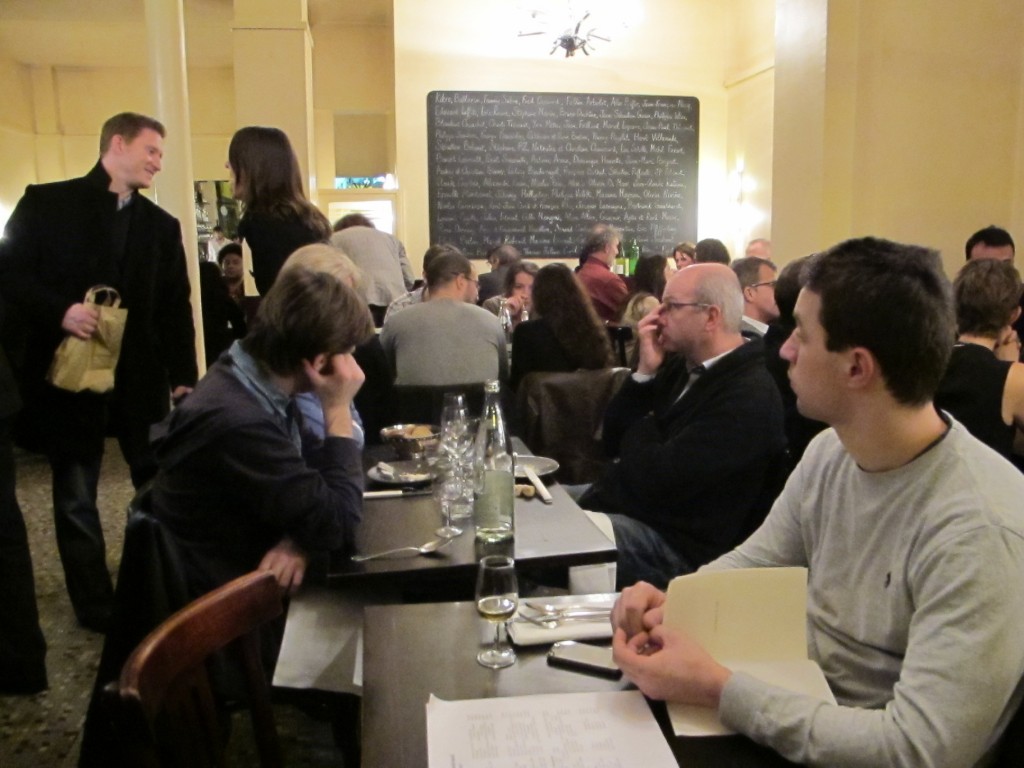
I think I was finally seated about 10:15pm in the back in front of what looks here like a chalkboard, but I think was a piece of art. It’s a buzzy place, charming in not being over-designed. I find it amusing that the name of the restaurant calls up an idea of traditional gastronomy, but the menu is anything but. At the last minute I decided to go for the matching wines (an additional 40 Euros to the 50 Euros menu, perhaps not quite as good a deal as the food). I won’t be able to discuss them here, as I have no idea what they were! The waiter (who as soon as I was seated was personable and attentive) would serve the wine, say “it is made by” and then mention a name I’d never heard of.

There was not one but many amuse-bouches. A piece of fish in anisette liqueur, some small delicate pastries…
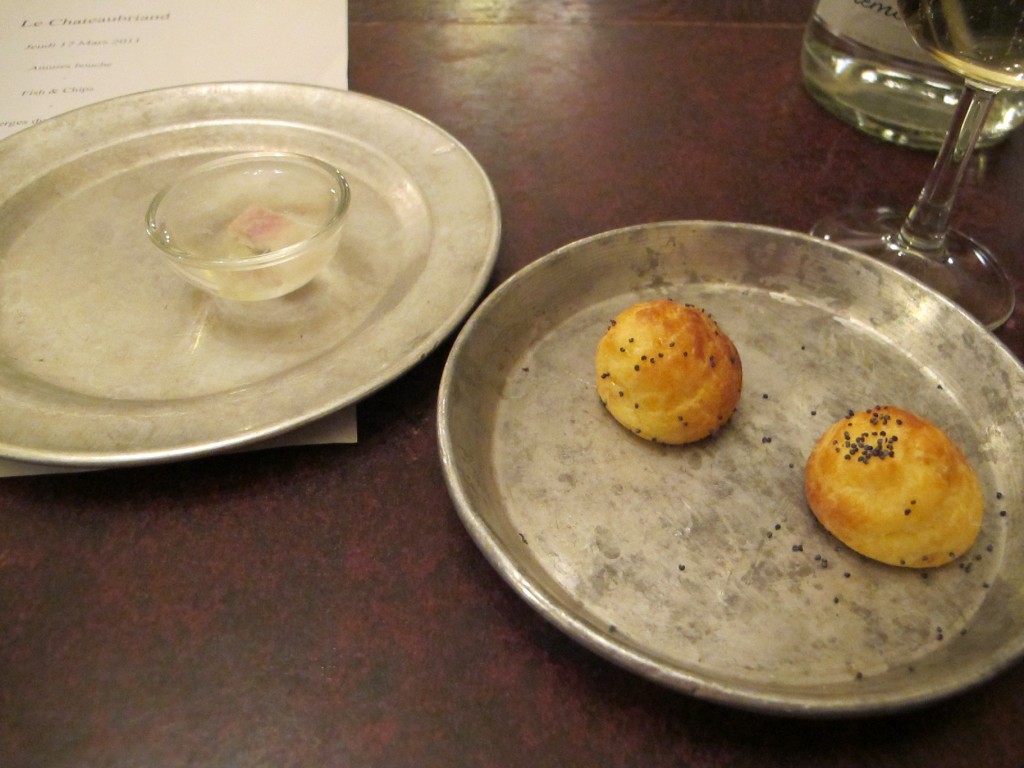
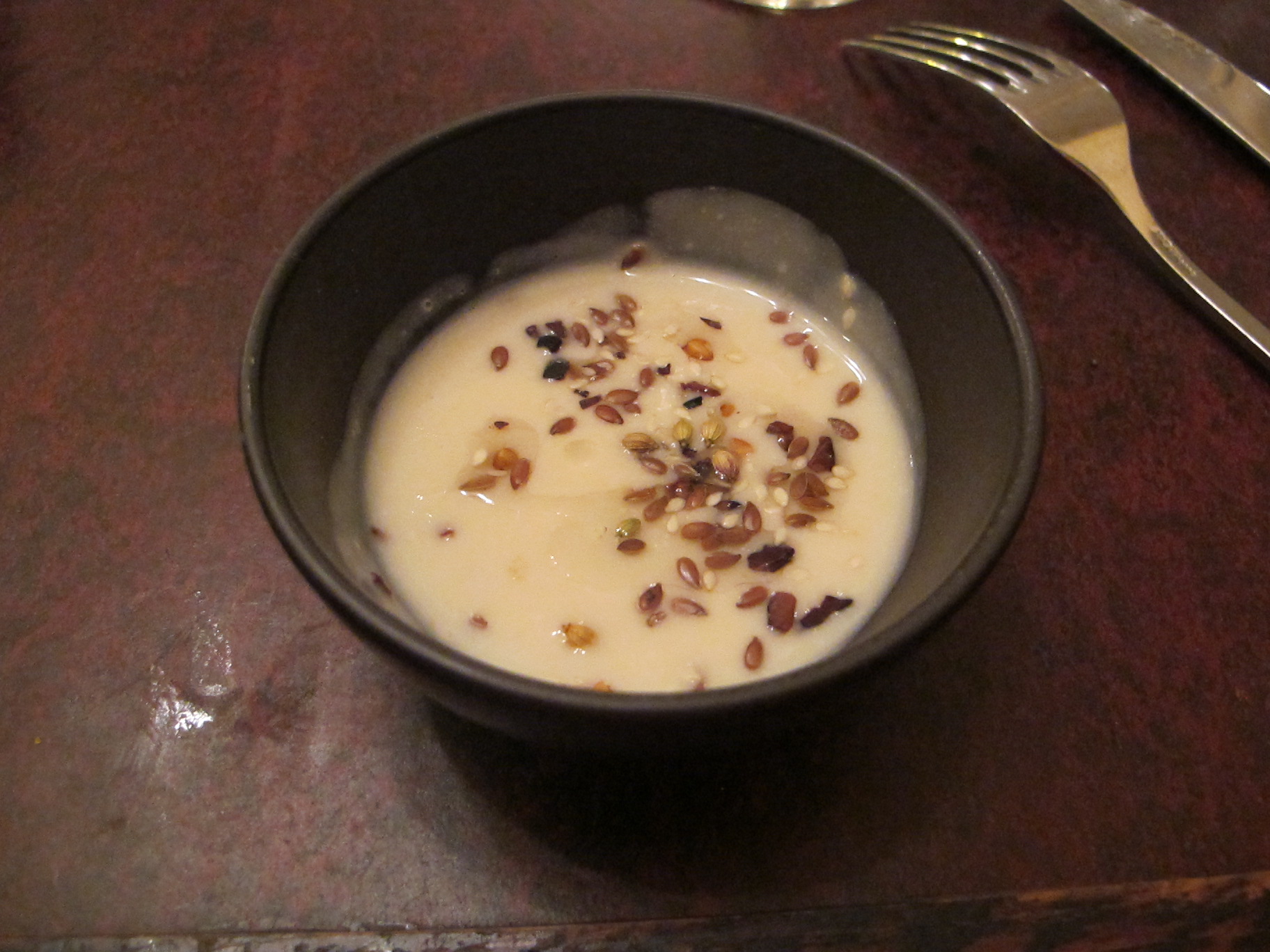
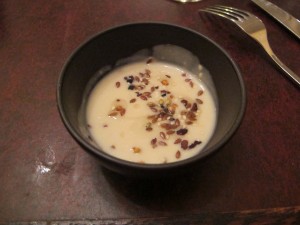
And a very delicious cauliflower soup with sesame seeds, and a small piece of pork – speck? I somehow missed taking a photo of the small piece of ris de veau (calf sweetbread) with equally sized pieces of cumquat and carrot, and the sea urchin with a mysterious green sauce on a watercress leaf.
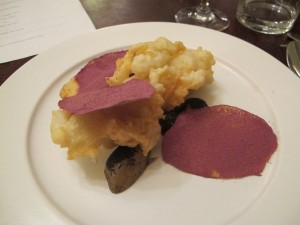
The first proper course was “Fish & Chips” but what an interesting interpretation!

Crisp, battered fish, so light it was almost not even there  – matched with three thin potato chips covered in tamarind powder (which made me cough) and 2 small hard potatoes.
 

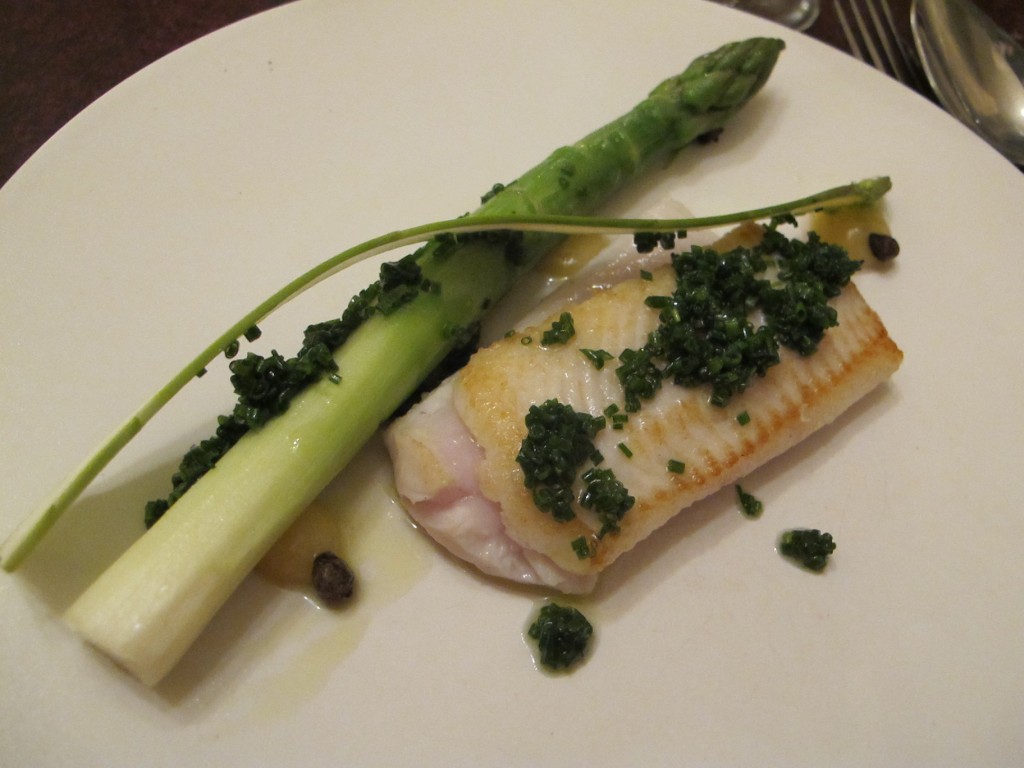
The next dish was also fish, but a complete contrast. A beautiful, slightly under-done piece of sole (‘LImande sole’), with one thin raw slice of Asparagus (‘asperges du Vaucluse’) matched with a cooked stalk that tasted watery and crisp at the same time, the essence of the vegetable, with a sauce of beurre noisette sauce and a sprinkling of some yummy unidentifiable green things.
I was seated side by side with a Japanese woman, Noriko, who spoke to me while her friend, a tall handsome bearded Frenchman, was in the lavatory. During this time of the typhoon and earthquakes, she wanted to know whether I was Japanese, as she felt like reaching out to fellow countrymen. We chatted after that, occasionally, during the meal, and I enjoyed hearing their praise for the food, and sounds of enjoyment. We both agreed that the next course tasted Japanese, “Boeuf, Hareng, Pickles”, was the softest beef with radish, pickles and a mushroom in a herring broth that was both savoury and sour. I think it was the most unFrench flavours that I ate in my three days!

The dessert was Endive, orange, olive… It was served with a liqueur of white quince, which was lovely. An intense orange sherbet, olive ‘soil’, and a piece of orange, and endives with a surprisingly sweet watery crunch. Interesting and engaging.
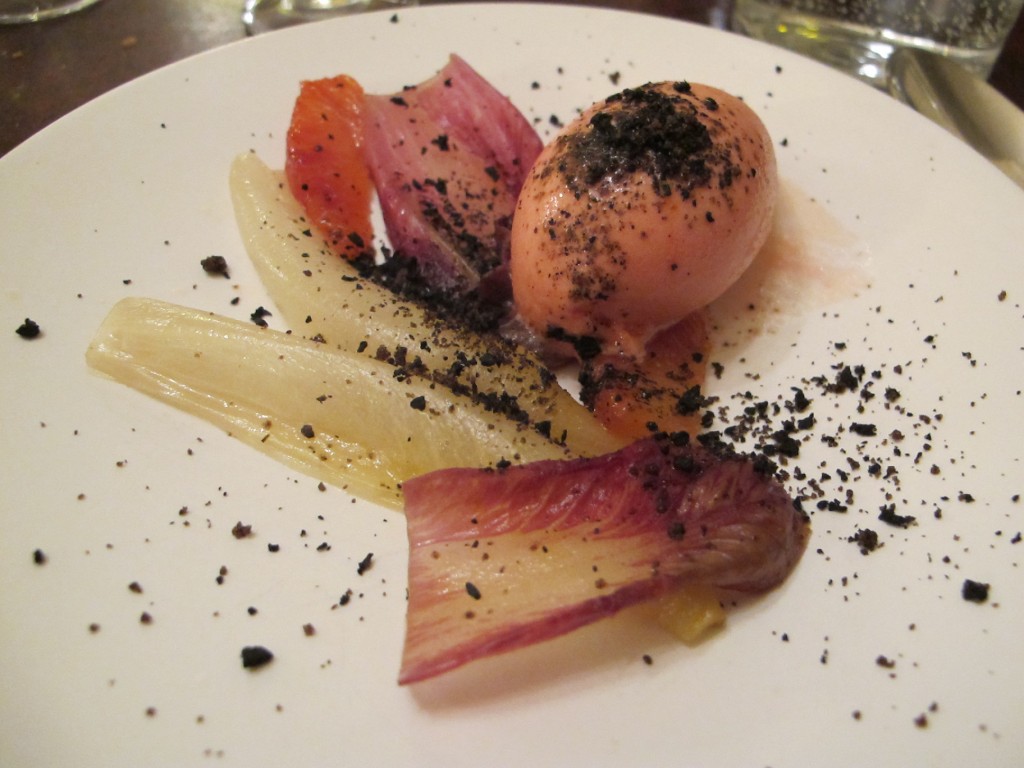
The second dessert was a choice of the daily cheese, which I would have loved to try, and what I did try: chocolate and celery.
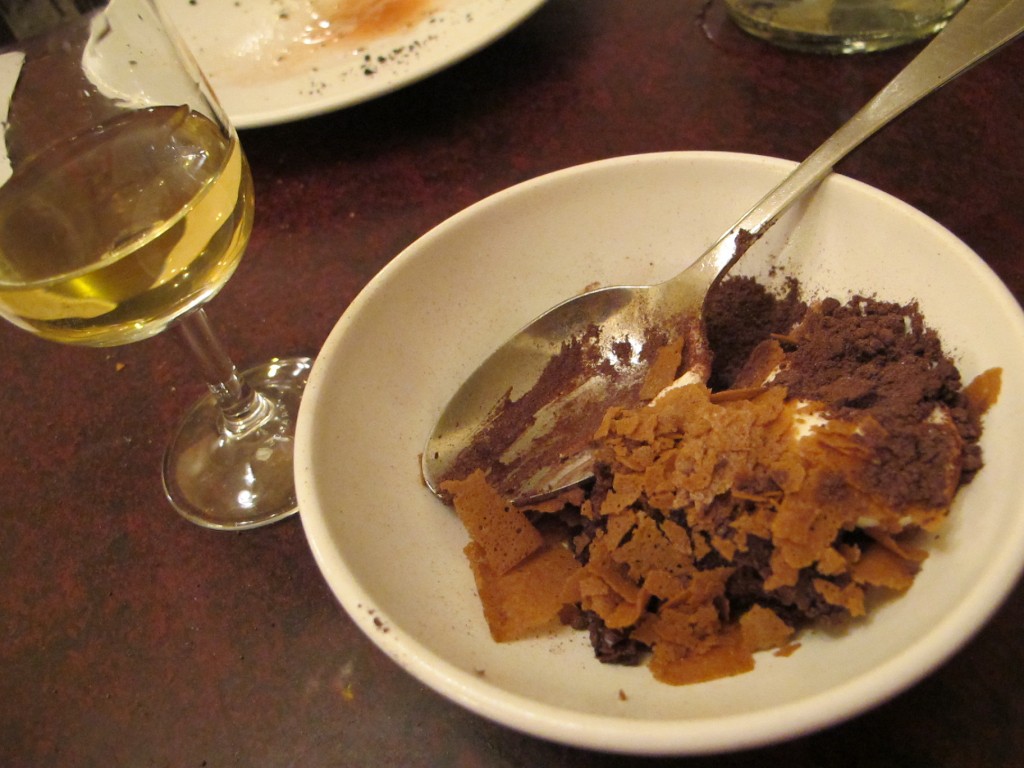
Chocolate powder, which made me cough like the tamarind stuff, cream, broken flaky cookies, and something chocolatey with a brownie-like texture. Is that where the celery was hidden, because I couldn’t find any? It looked like a mess, but I was so intrigued by all the textures and trying to guess the celery that I quite enjoyed it.

It was well past midnight when I finished the meal (and in a food coma). I was amused that the Frenchman next to me struck a conversation up with the chef as he was headed out the door (they were actually going out to karaoke. I wonder what he sang). I’m just in the neighbourhood, he told him, though I haven’t eaten here before. It was wonderful. And then they exchanged mobile phone numbers, either to help the Frenchman get reservations when he wanted, or because they were going to become best friends. I’m not sure. I thanked the chef as well (here in the stylish coat with unusual collar), Iñaki Aizpitarte, of French-Basque origins, and said, you’re famous, the review in the New York Times was how I found out about the restaurant.
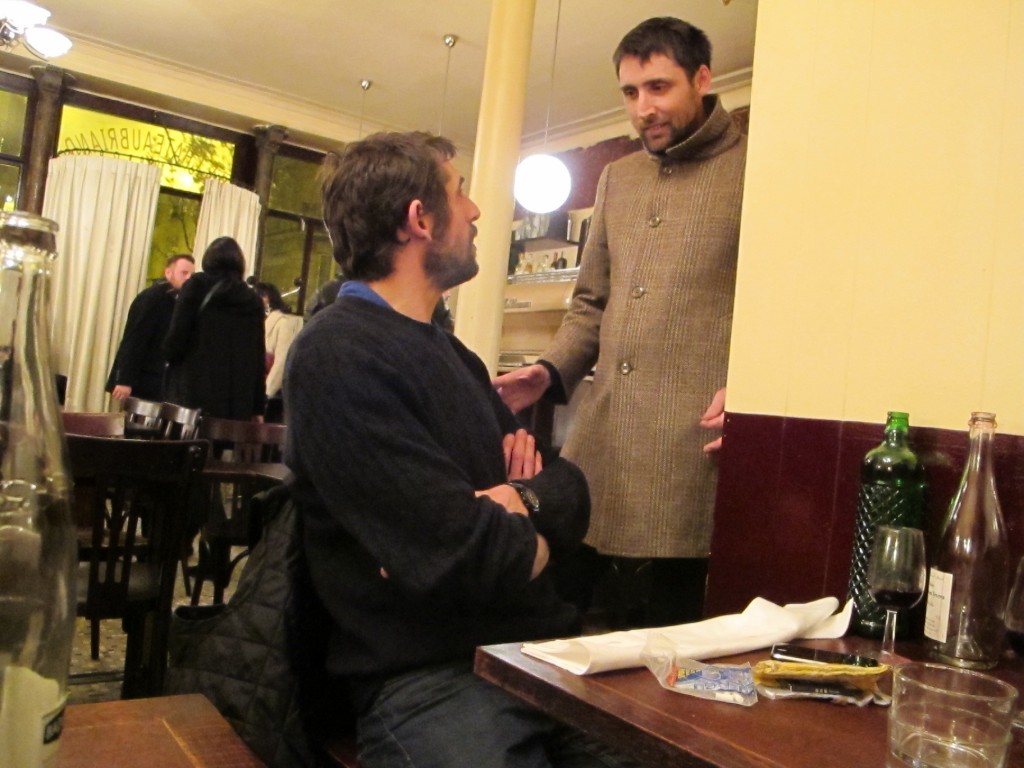
“But that is not the point, I don’t care about that,” he said nonchalantly. The way he spoke indicated an artistic temperament and somehow summarized a particular feeling I get from Parisians: pride, a commitment to beauty and art, a dismissal of those who don’t share the same viewpoint. “What is important,” he told me “is what you thought of the meal.”

I didn’t need to say it. Fantastique.

[And finally, a little web-surfing and I found out that Le Chateaubriand ranked 11th of the 2011 San Pelligrino’s World’s 50 Best Restaurants, replacing last year’s 11th ranked restaurant which has now dropped to 16, L’Astrance, where I went for a special meal in 2009. Hmm, perhaps this should be my bucket list. But anyways, Le Chateaubriand was a lucky choice, and definitely the right one.]

Posted in Food n' Grog, Paris, Review, Travel | Leave a comment

Paris Food Adventures, Day 2: Le Bistrot Des Comperes

Ah, Day 2 of my Paris Food Adventures, and dear reader, I was failing. After three amazing, rich meals in a row, I didn’t have the strength to search for another bistro mentioned in the New York Times and try to get into a second sitting. And it was really, really cold outside. So, I thought I’d do a little research.

The evolution of travel has been fascinating. In my university days, fellow travellers would debate the merits of Let’s Go vs. Lonely Planet. We would pour through pages written by expert travellers to find the right hotels and restaurants, and show up to see if there was space. But nowadays everything is available through e-mail. Trips are researched beforehand, reservations made online, and that privileged position of reviewer has broken down into the wisdom of the masses. An internet connection is an essential feature of a hotel room.

Did you know that on googlemaps you can simply enter the name of the neighbourhood where you wish to dine and the word “restaurants”. So, from my hotel on the lovely street Rue Malher, I connected to wireless, and didn’t even have to fill in the full search name – the autofill function turned ‘Restaurants 4eme’ into ‘Restaurants in 4ème Arrondissement, Paris, France’. Zooming in on my area showed me a dozen restaurants less than 5 minutes away, and a sidebar shows details with links to reviews. The reviews with Google are a bit of a muddle though, they’re grabbed from all over the net (and in different languages too)

So, to tripadvisor we go, which with some sort of complicated algorithm rates all of the restaurants in a city that it has listings for. I’m not sure I’m completely trustworthy of it. The current Number One restaurant in Paris only has 13 reviews. Certainly, the 3rd rated “Le Relais d’Isle” with 206 ratings should get some bonus points for that? There’s also no distinction between kinds of eateries, so Pierre Herme, with its fabulous macarons comes in at #16. Still, if you’ve made it in the top 100 of 6,593 restaurants, you must be doing something right.

The Sydney listings give me a better idea of how the list works. A restaurant that only has a handful of reviews, but all good, is going to be advantaged (though I suppose one bad rating could bring that score down quickly). But more importantly, the lists are skewed to tourists and travellers (which makes sense, it being tripadvisor) rather than locals. I assume that the number one rated Medusa Greek Tavern (which I’ve never heard of) is surrounded by hotels in its downtown location, with possibly a good reputation with hotel concierges! Meanwhile, Captain Cook Cruises rates as the 12th best restaurant in Sydney over 14th placed Tetsuya’s, which is probably the best restaurant in Sydney, though most reviews seem to talk about the views of the Harbour rather than the food.

But I digress. Le Bistrot Des Comperes, at #22 in Paris (formerly called Le Framboisy), received rave reviews, as well as sounding like a cozy neighbourhood restaurant. I was surprised I got in, but there was an empty table waiting for me, after walking down rue Charlemagne, a quiet street just south of St. Paul’s metro station, to find a warmly lit set of windows, a classic French bistro. I should perhaps have taken other reviewers’ advice and had the entree of Chevre onion confit creme brulee but was instead tempted by the home made foie-gras on a salad with smoked duck. The cranberry-like sauce on the foie gras reminded me of Thanksgiving turkey and the dressing was a little wet and sweet. But it was tasty.


For the main, a special of the day. A beef bourguignon of sorts. I looked a little too excited when the waiter mentioned it, imagining the dish I remembered from the movie ‘Julie and Julia’. He explained that it wasn’t exactly traditional, more like a beef stew.


With the perfectly cooked green beans, and the mashed potatoes, it was a hearty, savoury meal that went well with my glass of red wine.

I was too full for dessert though tempted by the homemade profiteroles.

It was a pleasant evening and what I was looking for. Not too much food, and not too fancy. It was still rich though – being French food. To tell the truth, I think the high ratings come as much from the charm of the place and location than the food – it offers tourists an authentic French experience in a charming bistro and on a chilly Paris night, not quite Spring, what more could one want?

Arriving back to Australia I receive an email messages from the restaurant. I only gave them 3 stars. Couldn’t I rate them higher? Ah: so that’s how they have such a high tripadvisor rating!


Posted in Food n' Grog, Paris, Travel | Leave a comment