Books I read in 2012

March already, and I never posted this up…

  • Michael Ondaatje’s The Cat’s Table (Fiction) – My god, did I love this. What a great start to the year for reading.
  • Tara Moss’s Split (Crime/Thriller)
  • David Musgrave’s Phantom Limb (Poetry)
  • Barbara Kingsolver’s The Poisonwood Bible (Fiction)
  • Andy Kissane’s Out to Lunch (Poetry)
  • Bernhard Schlink’s The Reader (Fiction)
  • Assaracus, A Journal of Gay Poetry, Issue 6 (Poetry) – Normally I don’t list journals and magazines, but it was a good read and I was honoured to have my poems included in it.
  • Joyce Carol Oates’ I’ll Take You There (Fiction) – Always wondered what her writing was like. I enjoyed it enough, not spectacularly. The story was contained and I didn’t fall into it. But she’s a good writer.
  • Alex Miller’s Lovesong (Fiction) – One of Australia’s more prominent writers – I enjoyed this, a good story, readable, engaging. Something fairly direct about his style. It was an interesting contrast to the Oates book.
  • Armistaud Maupin’s Mary Ann in Autumn (Fiction) – A return to the Tales of the City series that I loved so much. This was a pretty good return to form as I didn’t love ‘Michael Tolliver Lives’.
  • Nicole Mones’ a cup of light (Fiction) – an interesting enough exploration of the world of Chinese porcelain. Well-told.
  • Shane Koyczan’s Our Deathbeds Will Be Thirsty (Poetry)
  • Jennifer Egan’s Emerald City (Short Fiction)
  • Bonny Cassidy’s Certain Fathoms (Poetry)
  • Benjamin Law’s Gaysia (Non-fiction)
  • Leigh Stein’s Dispatch from the Future (Poetry)
  • Karen Russell’s Swamplandia! (Fiction)
  • Kate Fagan’s First Light (Poetry)
  • Ruth Park’s Harp in the South (Fiction)
  • Toby Fitch’s Rawshock (Poetry)
  • David Adams Richards’s Mercy Among The Children (Fiction)
  • Ahn Do’s The Happiest Refugee (Memoir)

Posted in Book, Books, Review | Leave a comment

Restaurant Review: Momofuku Seibo Redux

Even though it hasn’t been all that long since I’ve been to Sydney’s hottest new restaurant (though Movida these days seems to be giving it a run for its money), it was entirely necessary to go again so that the fabulous Leslie could experience it. Along with Sarah and Frank, we sat down on Friday night to an amazing meal matched with various alcoholic substances.

What surprised me was how thrilling I found it, even though I’d eaten there not that long ago. Probably about one-third of the dishes were the same, and the rest were different. Some of the drink-matching was the same, but others were also different.

What I loved was the elevation of something simple and basic to be a part of a complex and modern dish. A brocolli stalk, for crying out loud. Not even the floret. Perfectly done to accompany one of the dishes. Similarly, blanched almonds, or a small grilled piece of lettuce, were small simple foods put into a very different context. Here are the lettuce and the almonds alongside a very tasty piece of lamb (with a slightly bitter eggplant paste):

IMG_1423

We were so caught up in the food that I don’t have a photo of my favourite dish of the night, another example of the elevation of the common (or even the discarded). Potatoes confit in beef fat, and then fried in chicken fat so they’re sticky and rich. It was like a whole roast dinner in one bite. These were accompanied by four crispy deep-fried chicken’s tails (or popes’ or parsons’ noses…), a part of the chicken which I think most people shy away from. As well, wafer thin slices of regular old button mushrooms, unrecognisable. All of these humble foods ramped up into an amazing, amazing dish. Here’s a photo from yelp (click on it so I don’t violate someone’s copyright…)

The other highlight for me was a modernised congee. Instead of a big thick bowl of soup, they’d somehow reduced the congee to a small disc of its creamy essence (which tastes of home and comfort and childhood, at least if you were an Asian child!). Then instead of a big hunk of fried bread (yum) torn into pieces, they’d do miniature versions, the size of quail eggs. Instead of a piece of hard-boiled or preserved egg, there was an amazing translucent disc of egg yolk. And to literally top it all off, they poured an earl grey tea sauce into it. It was salty, so I thought it might have been soy sauce, but as the menu says ‘ham’, I suspect that the ham was infused into the tea. Somehow.

IMG_1422

What else? We all liked the smoked eel/apple crispy little starter. The famous steamed bun with pork belly was as good as ever. The striped trumpeter with celery and mustard was made more amazing because the wine somehow played off against celery flavour. The thin, crispy roll of beef tongue with black garlic and zucchini also yummy and the marron with the afore-mentioned broccoli and lemon was amazing. Yum. Desserts were simple and not too sweet, a curd with blackcurrant and mint, a cucumber, raspberry and elderflower combination of foam and gelato, and then an absolutely amazing grilled pineapple with white chocolate and… oh, I don’t know. It was just so tasty we couldn’t figure it out:

IMG_1424

As with the last time I went (and I didn’t say a thing to my dining companions before they tried it), we all agreed that the radish dish, beautiful as it is, didn’t work for us. The fermented black bean sauce is harsh and earthy, the small bits of wagyu beef too small to taste, and not sure where the watermelon went. The red rice wine sake that went with it was amazing, and the sweetness did make the dish more palatable, but generally: no.

I managed to keep the surprise from my dining companions about the Petit Four being slow-cooked pork (Porky Four they deemed it, which I thought was very clever). An amazing meal, so much that I can write about the same restaurant again and not feel repetitive, great company (thanks guys), a substantial bill (!), great memories, and not quite enough food photos, even if they can be found elsewhere on the web…

[Newer review for Momofuku Seibo, here]

Posted in Australia, Food n' Grog, Review | Leave a comment

Books I’ve Read: 2010 and before

I first kept this list on my webpage, but then figured that it would be easier to edit (and access) on my blog. So, I started this list on 7 July 2008 (my 39th birthday), and try to keep it up to date when I can, more for me than anyone else! This is the archival post with 2010 and before. From 2011 onwards, you can search for my yearly reading lists…

I’ve kept an informal list of books I’ve read in the last few years though I’ve missed recording a number. I sometimes get this feeling I don’t read enough – but then realise that I actually read a lot, especially on planes and in hotel rooms, with all the work travel I was doing. Now, with less travel, I’m making more of an effort to make time for reading when I’m not on a plane!

Miscellaneous books that I read and loved (before I started keeping this list)
  • Milan Kundera’s Unbearable Lightness of Being (and others)
  • Alice Munro’s Short Story collections
  • Lorrie Moore’s Birds of America
  • Edmund White’s Boy’s Own Story (and others)
  • Favourite poets (of which I’ve usually read a few of their books): Margaret Atwood (Selected Poems 2 is excellent), Mark Doty, Sharon Olds, Patrick Lane, Pablo Neruda.
  • Anne-Marie MacDonald’s Fall On Your Knees
  • Wole Soyinka’s Season of Anomy
  • Salman Rushdie’s novels (particularly Midnight’s Children, Satanic Verses)
  • Paul Monette’s Becoming a Man: Half a Life Story
  • James Merrill’s Changing Light at Sandover
Bolded means that I think your life is less complete without reading this book (or at least that I really really loved the book).

2010

  • Jee Leong Koh’s Equal to the Earth (Poetry)
  • Eli Jaxon-Bear’s The Enneagram of Liberation (Spirituality)
  • John Miller’s A Sharp Intake of Breath (Fiction)
  • Dr Arthur Agaston’s South Beach Diet (Diet/Health)
  • Tracy Quan’s Diary of a Jet-Setting Call Girl (Chick-Lit) – The adventures of Nancy Chan. Should I admit that I was looking to see if Borders carried my own book (er… no) and found instead another author named Quan? I’ve read all of her books (three so far) and found them very enjoyable. Taking the Sex-and-the-City genre and making the protagonist a sexy, Asian-American call girl living in the Big Apple – how could I resist?
  • Christos Tsiolkas’ The Slap (Fiction) – I’m elevating this to a recommendation. I’m not in love with the actual writing but Tsiolkas’ characters are wonderfully-drawn, the story contemporary and the momentum of the prose unstoppable – and it’s a great portrait of modern Australia.
  • Tom Cardamone’s The Lost Library, Gay Fiction Rediscovered (Essays/Gay History)
  • Eve Escher-Hogan’s Way of the Winding Path: A Map for the Labyrinth of Life (Spirituality)
  • Gabrielle Roth’s Sweat Your Prayers (Spirituality)
  • Blaine Marchand’s The Craving of Knives (Poetry)
  • On The Line: the Creation of the Chorus Line (Non-Fiction)
  • John Barton’s Hymn (Poetry)
  • J.A.G. Roberts’ China to Chinatown: Chinese Food in the West (Non-Fiction)
  • Paul Kane’s Work Life (Poetry) – Holy Cow, I liked this book of poems. Am going to search out more of his work now.
  • Junot Diaz’s The Brief Wondrous Life of Oscar Wao (Fiction) – The writing in this book is so energetic, I read it in a few days, very impressed. Wonder what the experience is for readers who have no Spanish language background at all as he drops Spanish words and slang into the text regularly.
  • Kevin Killian’s Argento Series (Poetry)
  • Jerome Parisse’s The Wings of Leo Spencer (Young Adult) – A friend published his first novel, a story about angels and families. I don’t know if I’ve ever read a “young adult” book but it was engaging.
  • Roberta Lowing’s Notorious (Fiction) – A friend gave me a pre-publication copy of this to read, by someone I know who organised a poetry reading series. It’s an ambitious thriller, or sorts, that moves between Italy and Poland and Morocco.
  • Kate Story’s Blasted (Fiction) – I went to college (and university) with Kate and was excited to order her first novel – it’s engaging and surprising with some really lovely writing.
  • Chris Adrian’s A Better Angel (Short Fiction) – Loved a story by this guy in the New Yorker. This is a beautiful collection.
  • Steig Larsson’s Girl with the Dragon Tattoo, Girl Who Played With Fire, Girl who Kicked the Hornets Nest (Thrillers) – Completely addictive and enjoyable..
  • Jonathan Franzen’s Freedom (Fiction) – As with the Corrections, I loved it. It’s my 2010 must-read recommendation.
  • David Caleb Acevedo’s Bestiario en nomenclatura binomial (Poetry in Spanish)
  • Sara Gruen’s Ape House (Fiction) – What a disappointment. Water for Elephants really grabbed me, but this had poor writing and, one-dimensional characters. The pain of it increased because of my expectations for it. 
  • Jeannette Winterston’s Lighthousekeeping (Fiction)
  • Ken Wilber’s the Integral Vision (Philosophy) – I think this guy is a really interesting thinker and this made me think about a lot of things…
  • Andrew O Hagan’s The Life and Opinions of Maf the Dog, and of his friend Marilyn Monroe – completely surprising. From the cover and title and marketing, I just wasn’t sure, but my pal Chris said it was good, and by the first page, I could see what a beautiful writer Hagan is. I really liked it.
  • Kimberley Mann’s Awake During Anaesthetic (Poetry Chapbook)
  • Bonny Cassidy’s Said to be Standing (Poetry Chapbook) – Vagabond Press produces these absolutely beautiful chapbooks called “Rare Objects” and they’re publishing usually emerging poets. Great stuff, good to read Bonny’s work as I’ve heard her read before.
  • Stuart Cooke’s Corrosions (Poetry Chapbook) – Ditto above, and *great* to read Stuart’s work as I haven’t really heard him read before. Interesting range of poems here.
  • Benjamin Law’s the Family Law (Humour/Family) – Very enjoyable, great voice, great writing from a young, gay Asian writer from Brisbane
  • Graeme Aitken’s The Indignities (Fiction) – A fun, gay romp through Sydney, circa 2004.

2009

  • Anne Enright’s The Gathering (Fiction) – Booker winner, and she went to my international college, many moons ago. I can see why people had trouble with it – as I see it hasn’t gotten universally great reviews. There’s something unsentimental and hard about it, but it’s also an amazing book.
  • Mark Haddon’s The Curious Incident of the Dog in the Night-Time (Fiction) – Now this is the type of book that readers like – engaging, original, accessible. Both gritty and sweet. I can see why it was a best-seller, and enjoyed it myself.
  • Reading Six Feet Under – TV to Die For (Cultural Studies) – not for everyone, academic analyses of different themes in the TV show, but it allowed me, with pleasure, to revisit the best TV show ever.
  • Alice Sebold’s The Almost Moon (Fiction) – it didn’t grab me, or was this just because The Lovely Bones was so unforgettably good.
  • Dorothy Porter’s The Bee Hut (Poetry) – a beautiful short collection, published posthumously and including some of the last poems of this very original voice.
  • Norman Doidge’s The Brain That Changes Itself (Science) – thought about this for weeks, talked about it with friends for weeks. Still affecting the way I view the world.
  • Lorrie Moore’s Collected Stories (Short Fiction)
  • Tara Moss’ Fetish (Crime/Thriller)
  • Robert Bly’s translation of Rumi, The Kabir Book (Poetry).
  • Haruki Murukami’s Dance Dance Dance (Fiction) – Wow, does this man have an interesting mind. Really enjoyed it.
  • Henry James’ The Aspern Papers (Fiction) – since I was passing through Venice, I took a friend’s recommendation to read this slim book set in Venice. Now I can say I’ve read some Henry James…
  • Tim Winton’s Breath (Fiction) – A lot packed into this short novel.
  • Second Person Queer (Essays) – Finally read this anthology that I was included in. A few great pieces, not sure whether the idea works as a whole book.
  • James Robert Baker’s Adrenalin (Fiction) – Phew. A wild ride, read on the high recommendations of friends who are huge fans of his. A piece of gay history.
  • David Ebershoff’s the 19th wife (Fiction) – Interesting topic. Didn’t like it as much as the Danish Girl.
  • Tim Winton’s Dirt Music (Fiction) – God I loved this book. Great introduction for me to a premier Australian writer.
  • Dashiell Hammett’s The Maltese Falcon (Crime) – read for a literary salon which I eventually couldn’t make it too. Darn. Could see it was the model for much of what followed – but didn’t love it.
  • Dorothy Porter’s Monkey’s Mask (Poetry/Crime) – also (re)read this for the salon. Amazing book. Quick read!
  • Michael Ondaatje’s In The Skin of The Lion (Fiction) – I read this aloud to my partner – an interesting experiment. When are they going to make a movie of this?
  • Kate Atkinson’s When Will There Be Good News? (Crime Fiction) – A nice surprise, as I loved her first novel, to see she’s turned to crime… and with a great story and characters. sweartogod.
  • Anne Enright’s Yesterday’s Weather (Short Fiction) – Enjoyed them. Now curious to read her Booker Prize winning novel.
  • Edmund White’s Hotel de Dream (Fiction)
  • Tom Cho’s Look Who’s Morphing (Short Fiction)
  • Ken Wilber’s Grace and Grit (Philosophy/Biography) – I’m loving this book as I read it and it’s changing the way I think about spirituality, enlightenment, disease and the new age movement.
  • Levitt and Dubner’s Freakonomics (Culture/Non-Fiction). A great read. Fun and insightful and challenging.
  • Alice Munro’s Lives of Girls and Women (Fiction). I’m a huge fan of Alice Munro – and it was interesting to read one of her early books.
  • Best American Poetry 2008 (Poetry) – My pal John introduced me to this series years ago. I really like this year’s collection. Some stunning work.
  • Salman Rushdie’s The Enchantress of Florence (Fiction) – completely adored this.
  • Best Gay Poetry 2008 (Poetry) – some amazing work in here
  • The Kite Runner (Fiction) – Good story but I didn’t love the writing itself. Maybe I expected too much because of the hype.

2008

  • Markus Zusak’s The Book Thief (Fiction)
  • Sara Gruen’s Water for Elephants (Fiction)
  • Sean Horlor’s Made Beautiful By Use (Poetry)
  • Lorna Crozier’s Whetstone (Poetry) Stunning.
  • Sharon Olds’ Blood, Tin, Straw (Poetry)
  • Miranda July’s No One Belongs Here More Than You (Short Fiction)
  • Alex Boyd’s Making Bones Walk (Poetry)
  • Fiona Tinwei Lam’s Intimate Distances (Poetry)
  • Anne-Marie MacDonald’s Fall On Your Knees (Fiction)Reread it to see if I still liked it as much. I did.
  • Margaret Atwood’s Moral Disorder (Short Fiction)
  • Jes Battis’ Night Child (Fantasy)
  • Kazuo Ishiguro’s Never Let Me Go (Fiction)
  • Elizabeth Bishop’s Eat Pray Love (Memoir)
  • Alain de Botton’s Essays on Love (Fiction)
  • Sarah McDonald’s Holy Cow (Memoir)
  • Keirsey’s Please Understand Me II (Personality Test)
  • Nam Le’s The Boat (Short Fiction)
  • Brian Rigg’s A False Paradise (Poetry)
  • Augusten Buroughs’ A Wolf at the Table (Memoir)
  • Sarah McDonald’s Holy Cow (Memoir/Travel)
  • Candace Bushell’s Sex and the City (Fiction/Journalism)
  • Martin Harrison’s Wild Bees (Poetry)
  • Alan Weiss’ Getting Started in Consulting (Business)
  • John Gould’s Kilter (Short Short Fiction)
  • A.M.Homes’ Things You Should Know (Short Fiction)
  • Eduardo Galeano’s Memory of Fire (History/Fiction)
  • Paulo Coelho’s The Alchemist (Fiction)
  • Raimond Gaita’s Romulus, My Father (Biography) – Loved this book as a portrayal of immigrant Australia. Great characters, great storytelling.
  • David Marr’s The Henson Case (Non-Fiction) – A clear, lucid account of the Bill Henson controversy
  • Kevin Hart’s Flame Tree: Selected Poems (Poetry)
  • Colin Carberry’s Ceasefire in Purgatory (Poetry)
  • Michael Ondaatje’s Divisadero (Fiction) – Great finish to the year. What a beautiful book.

2007

  • Alain De Botton’s The Art of Travel (Philosophy)
  • Henri von Doussa’s The Park Bench (Fiction)
  • Jonathan Lethem’s Men and Cartoons (Short Fiction)
  • David Mitchell’s Ghostwritten (Fiction)
  • Linda Gregg’s Flesh and Things (Poetry)
  • Billy Collin’s Sailing Alone Around The Room: New and Selected Poems
  • Best American Poetry 2006
  • Jerry and Esther Hicks’ Ask and It Is Given (New Age/Philosophy)
  • Rattawut Lapcharoensap’s Sightseeing (Short Fiction)
  • Steven King’s On Writing (Non-Fiction)
  • Margaret Atwood’s Oryx and Crake (Fiction)
  • Alexander McCall Smith’s The No. Ladies’ Detective Agency (Fiction)
  • Truman Capote’s Breakfast at Tiffany’s (Fiction)
  • Jean-Dominique Bauby’s The Diving-Bell & The Butterfly (Memoir)
  • Anonymous’s The Bride Stripped Bare (Fiction)
  • Hunter S. Thompson’s Fear and Loathing in Law Vegas (Nonfiction/Journalism)
  • David Allen’s How to Get Things Done (Career/Self-Help)
  • Gangaji’s Diamond in Your Pocket (Spirituality)
  • Seminal: The Anthology of Canada’s Gay Male Poets (Poetry)
  • Patrick Lane’s What the Stones Remember (Memoir)
  • Eckhardt Tolle’s A New Earth (Philosophy)
  • Ben Elton’s High Society (Fiction)
  • Suzanne Chick’s Searching for Charmiane (Biography)
  • Tracy Quan’s Diary of a Married Call Girl (Fiction)
  • Alice Munro’s The View From Castle Rock (Memoir)
  • Margaret Atwood’s Moral Disorder (Short Fiction/Memoir)
  • Alice Niffenegger’s The Time Traveller’s Wife (Fiction)
  • Pablo Neruda’s Isla Negra (Poetry)
  • Milan Kundera’s Farewell Waltz (Fiction)
  • Salman Rushdie’s Grimus (Fiction)

2006

  • Mark Doty’s The Source (Poetry)
  • Mark Doty’s School of the Arts (Poetry)
  • Ken Wilber’s No Borders (Philosophy)
  • Stephen Greco’s The Sperm Engine (Erotica/Memoir)
  • Alice Munro’s Runaway (Short Fiction)
  • Sean Condon’s My ‘Dam Life (memoir/humour)
  • Daniel Gawthrop’s The Rice Queen Diaries (memoir)
  • Yann Martel’s The Life of Pi (Fiction)
  • Joanne Harris’ Chocolat (Fiction)
  • Edmund White’s My Lives (Autobiography)
  • Gregory Maguire’s Wicked (Fiction)
  • Michael V. Smith’s What You Can’t Have (Poetry)
  • George Ilsley’s ManBug (Fiction)
  • Edmund White’s My Lives (Autobiography)
  • Eckhardt Tolle’s The Power Of Now (Philosophy)
  • Shauna Singh Baldwin’s What the Body Remembers (Fiction)
  • Shalini Akhil’s The Bollywood Beauty (Fiction)
  • John Murray’s A Few Short Notes on Tropical Butterflies (Short Fiction)
  • Lorna Crozier’s What the Living Won’t Let Go (Poetry)

2005

  • Jonathan Franzen’s The Twenty-Seventh City (Novel)
  • Gerald Stern’s Last Blue (Poetry)
  • Alain De Botton’s Status Anxiety (Non-Fiction)
  • Michel Houellebecq’s Lanzerote (Fiction)
  • Noel Rowe’s Next to Nothing (Poetry)
  • Alan Hollinghurst’s The Line Of Beauty (Novel)
  • Dorothy Porter’s The Monkey’s Mask (Poetry)
  • Lynne Truss’ Eats, Shoots and Leaves (Non-Fiction)
  • Gerald Stern’s This Time (Poetry)
  • Malcolm Gladwell’s Blink (Non-Fiction)
  • Jill Jones’ Screen Jets Heaven (Poetry)
  • Marshall Moore’s Black Shapes in a Darkened Room (Short Fiction)
  • Sandra Alland’s A Shape of a Tongue (Poetry)
  • Victoria Finlay’s Colour: Travels through the Paintbox (Non-Fiction)
  • Michael Cunningham’s Land’s End (Non-Fiction)
  • Gerald Stern’s Lucky Life (Poetry)
  • Steve Kluger’s Almost Like Being in Love (Novel)
  • Tony Hoagland’s Donkey Gospel (Poetry)
  • Greg Wharton’s Johny Was and Other Tall Tales (Erotica)
  • Kevin Bentley’s Let’s Shut Out the World (Memoir)
  • Randall Mann’s Complaint in the Garden (Poetry)
  • Jameson Currier’s Desire, Lust, Passion, Sex (Short Fiction/Erotica)
  • Ann Hood’s An Orthinologist’s Guide to Life (Short Fiction)
  • Kevin Bentley’s Wild Animals I Have Known (Memoir)

2004

  • Best Gay Erotica 2004 (Erotica)
  • Mark Doty’s Still Life with Oranges and Lemons (Non-Fiction)
  • Peter Carey’s Oscar and Lucinda (Novel)
  • Gerald Stern’s American Sonnets (Poetry)
  • Peter Minter’s Empty Texas (Poetry)
  • The Complete Guide to Spirits and Liqueurs (Non-Fiction)
  • Best Gay Asian Erotica (Erotica)
  • David Sedaris’ Dress Your Family in Corduroy and Denim (Humour)
  • Ian Phillips and Greg Whartons’ Law of Desire (Erotica/Anthology)
  • Meanjin’s Australasian Issue (Review/Anthology)
  • Gerry Turcotte’s Winterlude (Poetry)
  • Philip Hammiel’s In the Year of our Lord’s Slaughter (Poetry)
  • Marshall Moore’s Ideal for Living (Novel)
  • Wayson Choy’s All That Matters (Novel)
  • Jeffrey Eugenides’ Middlesex (Novel)
  • George Ilsley’s Random Acts of Hatred (Short Fiction)
  • Anne-Marie MacDonald’s The Way the Crow Flies (Novel)

Around 2003

  • Best Gay Erotica 2003 (Erotica)
  • Tracey Quan’s Diary of a Manhattan Call Girl (Novel)
  • Jim Gladwell’s The Tipping Point (Non-Fiction)
  • Joel Tan’s Monster (Poetry)
  • Sharon Olds’ The Unswept Room (Poetry)
  • Laurie Moore’s Self-Help (Short Fiction)
  • Luke Davies’ Running with Light
  • Carol Shield’s Unless (Novel)
  • Kevin Bentley’s Boyfriends from Hell (Anthology)
  • David Sedaris’ Naked (Humour)
  • Kate Fagan’s The Long Moment (Poetry)
  • Michael Farrell’s Ode Ode (Poetry)

Around 2002

  • Michael Cunningham’s Home at the End of the World (Novel)
  • David Eberschoff’s Rose City (Short Fiction)
  • Michael Chabon’s Adventures of Cavalier and Clay (Novel)
  • Michael Ondaatje’s Anil’s Ghost (Novel)
  • Martin Foreman’s Butterfly’s Wing (Novel)
  • Noel Alumnit’s Letters to Montgomery Clift (Novel)
  • Michael Smith’s Cumberland (Novel)
  • Michael Cunningham’s Flesh and Blood (Novel)
  • Louis Bernieres’ Captain Corelli’s Mandolin (Novel)
  • Jonathan Franzen’s the Corrections (Novel)
  • Imogen Edward Jones’ My Canape Hell (Novel)
  • Scott Heim’s Mysterious Skin (Novel)
  • Colm Toibin’s The Story of the Night (Novel)
  • Eva Sebold’s The Lovely Bones (Novel)
  • Ursula Leguin’s The Other Wind (Novel)
  • Seamus Heaney’ The Open Ground (Poetry – Collected)

Around 2001

  • Dave Egger’s A Heartbreaking Work of Staggering Genius (Novel/Autobiography)
  • Jhumpa Lamphiri’s Interpreter of Maladies (Short Fiction)
  • Michael Cunningham’s The Hours (Novel)
  • Neal Drinnan’s Glove Puppet (Novel)
  • J.M. Coetzee’s Disgrace (Novel)
  • Nicholas Jose’s The Red Thread (Novel)
  • Blaine Marchand’s Bodily Presence (Poetry)
  • Billeh Nickerson’s Asthmatic Glassblower (Poetry)
  • Mitch Cullin’s From The Place in the Valley Deep in the Forest (Short Fiction)
  • Steve Kluger’s Last Days of Summer (Novel)
  • Neal Drinnan’s Pussy’s Bow (Novel)
  • Elizabeth Knox’s Vintner’s Luck (Novel)
  • Edmund White’s Farewell Symphony (Novel)
  • Francisco Ibanez’s Flesh Wounds and Purple Flowers (Novel)
  • Bruno Bouchet’s The Girls (Novel)
  • Dennis Altman’s Global Sex (Non-Fiction)
  • Micha Ramaker’s Art of Pleasure (Non-Fiction)
  • Marshall Moore’s the Concrete Sky (Novel)

Posted in Book Review, Books, Poetry | 1 Comment

Book Review: Benjamin Law’s Gaysia

GaysiaGaysia by Benjamin Law

My rating: 3 of 5 stars

I like to think it’s a compliment to a book if I’m interested enough in it, engaged or enraged, in order to want to write a review.

I also think (and I could have used this advice when younger) that discussion is better than silence.

I wax philosophical about book reviews because they’re strange beasts. The books that I tend to want to write about are from small publishers and by lesser-known authors (as I don’t feel a desire, usually, to add my opinion to a thousand others who have written about a bestseller).

But this means that the author of the book will most certainly see the review. I know this as an ego-surfing author. Of course you want to know what people have thought after having laboured over for so long. So, reviews can feel strangely personal these days.

Then to consider: do I feel comfortable being critical in a public space? Could it be misconstrued? Can the author involved see a criticism as directed towards a book rather than to the author (although this is often impossible to separate if the book is a personal one)?

Not that this review will be a bad one, for Gaysia is an enjoyable and intriguing read. But still, I remember taking my book reviews far too seriously, with phrases from them stuck in my brain for far too long. And because book reviews can be so scarce or insubstantial, a review can take on greater significance if it’s one of only a few.

But of course I was compelled to write about Gaysia. Being Gaysian and having written and commented on aspects of being Gaysian for so long, I was glad to buy the book at its launch in Sydney (having almost bought the e-book version a week before). I read it through quickly, and felt inspired to review it.

In any case: the book. Gaysia, written by journalist and writer Benjamin Law and published by Melbourne’s Black Inc., is a romp through various cities in Asia exploring various aspects of something related to ‘gay’ – celebrity drag queens in Tokyo, lady-boy beauty pageant contestants in Thailand, HIV-affected sex workers in Myanmar, an anti-gay yoga guru in India, and a formerly gay Malaysian pastor who runs a ‘conversion’ program to turn lesbians and gays straight. The section on China explores how gay men are using the internet, and how some seek marriage, either with lesbians or with straight women, for social acceptance.

In the first chapter, Law travels to Bali, stays at some gay nudist hotels and interviews men who have sex for money… or motorcycles. Law’s tone is set from the first paragraph. With tourists to Bali coming to ‘eat, drink and fuck’, or ‘have foreign strangers drunkenly fondle our inner selves’, Law uses sexually direct or explicit images or turns of phrase to amuse, shock and engage.

But part of his comedy (and Law is a very funny writer) is that he himself is scandalised by the goings-on. He’s wide-eyed at the sex happening among hotel guests. He’s poked and prodded and flirted with in his interviews with his much more colourful guests, and acts the supportive straight man, so to speak, nodding along in sympathy, both pushing the conversation along and then pulling back, an innocent observer.

It’s clear that Law is sympathetic to all of his interview subjects, except for perhaps a few of the anti-gay ones. There’s kindness in his approach. He jumps in to have a drink with them when not suffering from a travel-related illness. There’s no judgement nor trying to fit them into some sort of treatise on what it means to be gay in Asia or to a particular conception of gayness.

This works both ways. There’s only a brief introduction and no conclusion. While the book is called ‘Gaysia’, there’s no broad perspective or analysis on how gay identities are lived in Asia, and little reflection on the issue. For the countless hours of organisation, interviews, research and travel, there is a surprising lack of trying to pull together observations and perspective into narratives or conclusion. Instead, as a journalist choosing an angle for each country, the focus is on the best story – in Thailand, the ladyboys, in Japan, the drag queens. More ‘regular’ gay men and lesbians generally have much more minor roles; it’s hard to find a perspective on their lives.

Still, the book does not aim to provide analysis nor be an academic text – and how would one try to summarise gay sexuality in a continent as crazy and diverse as Asia? Or in countries as complex as the ones being written about? It’s not as if a reader would read the chapter on Malaysia and think: the Malaysian gay scene is dominated by anti-gay conversion therapy.

Or would they?

I wonder about that too, who the readership is for the book. Are they gay? Are they straight? How familiar will they be with the range of issues touched upon in this book and how will they relate to them?

I’ve always said that examining issues of sexuality and identity in countries should not be a minority issue, because how countries address sexual identity has a lot to say about their overall structures and traditions, contradictions and mores.

But I wonder about the book finding an audience, who it is and how it would be understood. And of course, I hope Gaysia has found a readership, as these snapshots of gay men and some lesbians, men who have sex with men, transsexuals, transvestites, drag queens, and gay and HIV activists, do offer an interesting perspective on their countries. The great title and bold cover should also help to attract, and Law is a popular twitter-user and journalist, so he’s using a unique position to get these issues out into the wider world.

Also evident is the strength of Law’s journalism and how he was able to wrangle and record hundreds of interviews and discussions. To his success, Law manages to position himself in a way that I doubt anyone else could have done. He gains empathy with most of his interview subjects as a gay Asian man yet plays along with his two anti-gay interviewees. He is both sympathetic and engaged with interview subjects but at the same time, an outside observer and commentator.

I found this positioning as intriguing as the stories himself. As I observed in his memoir, ‘The Family Law’, Law is a whole generation after me and the people with whom I forged my identity and engaged in gay activism. He happens to be gay. He happens to be Asian. Neither is particularly adopted as an identity. Neither is rejected. He doesn’t fit a gay stereotype of a tragic drama queen who has to move to the big city (and perform in musicals). He’s had a boyfriend since high school, and made a successful career in Brisbane. Why would he have to do or be anyone else?

But when he admits to never having been to a gay pride parade, and feels ‘something closely resembling pride’ while seeing pride march, a part of me asks, how can a writer write about gay issues without being particularly engaged in any way with gay identity or community?

As a writer who has built a foundation on exploring both gay and cultural identity, I feel an urge to know how Law feels about being Asian and travelling in Asia, and about how he situates his cultural identity within it. He does posit that if his parents had stayed in Malaysia, he might have encountered the same social pressures and prejudices of some of the lesbians and gay men he described – but this is really a brief mention.

But there’s the rub. This is a new world that doesn’t ask for coherence or grand narratives. We’re a twittering tweeting facebooking world, made up of pieces and soundbytes. The authority given to academics or other experts has broken down to give way to multiple opinions and voices. The snapshots of his subjects or even of himself seem to represent the diversity of identities and sexuality more accurately than if we’re actually sticking to categories of what it might mean to be ‘Asian’ or one of those letters in the terrible acronym GLBTIQA. These days we read about experiences and make our own analyses, however they fit into our own worlds. Along the way, I’d judge it a good thing to be entertained and engaged by good writing.

View all my reviews

Posted in Book Review | Leave a comment

Restaurant Review: Pei Modern, Melbourne

A few months ago, I found myself in Melbourne, and we were looking for somewhere to eat before going to see Geoffrey Rush in “A Funny Thing Happened On The Way To The Forum”.

Even though it was only about 5:30pm, Movida, which had opened at 5pm, was full (both Movidas!). Likewise, there was a line down the stairs and out the door of Mamacita. Whoah! What is it with this town and popular restaurants?

What about Pei Modern? Named after the famous architect, whose design was visible from the restaurant, it’s in a funny location, a little arcade outside of the Sofitel Hotel. I’d read good reviews so we stopped on by. We opted just to hang out in the casual area rather than the formal dining area, which suited us fine.

To start with, they offered a cocktail menu with about 4 variations of Negronis. Considering this is my favourite cocktail at the moment, you could imagine how happy I was.

The other kicker, for a Sydneysider, is that this restaurant is branded as a creation of Mark Best. Best’s Marque Restaurant in Sydney is one of our most renown. I’ve managed to get in for lunch one time. I liked it, but found some of the flavours unusual, and want to try it for dinner. Though when will that be? It’s a full commitment, a special occasion meal, planned in advance (as reservations are scarce) and pricy.

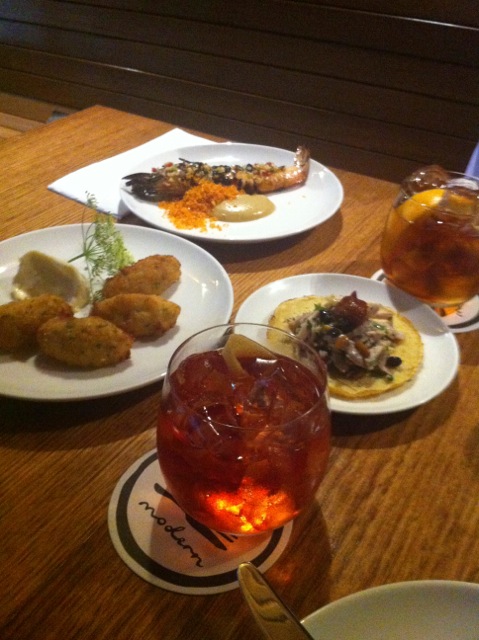
So, what’s not to like about a casual version of one of Sydney’s most famous chefs where normally you’d have to plan and reserve and here we waltzed in to try a selection of fast and absolutely delicious creations of his… Ortiz Shortbread and Parmesan Custard… Wood Grilled Prawn and Pork Salt (a new definition of ‘savoury’)… I think we tried a few more than this (the brandade croquettes, I think, and I think it was some sort of duck pancake), but in my estimation, these are top-notch, top-quality creative dishes from one of Australia’s best, in a casual atmosphere with reasonable prices and… negronis.

IMG_0774

Posted in Food n' Grog | Leave a comment

Sydney’s Labyrinth

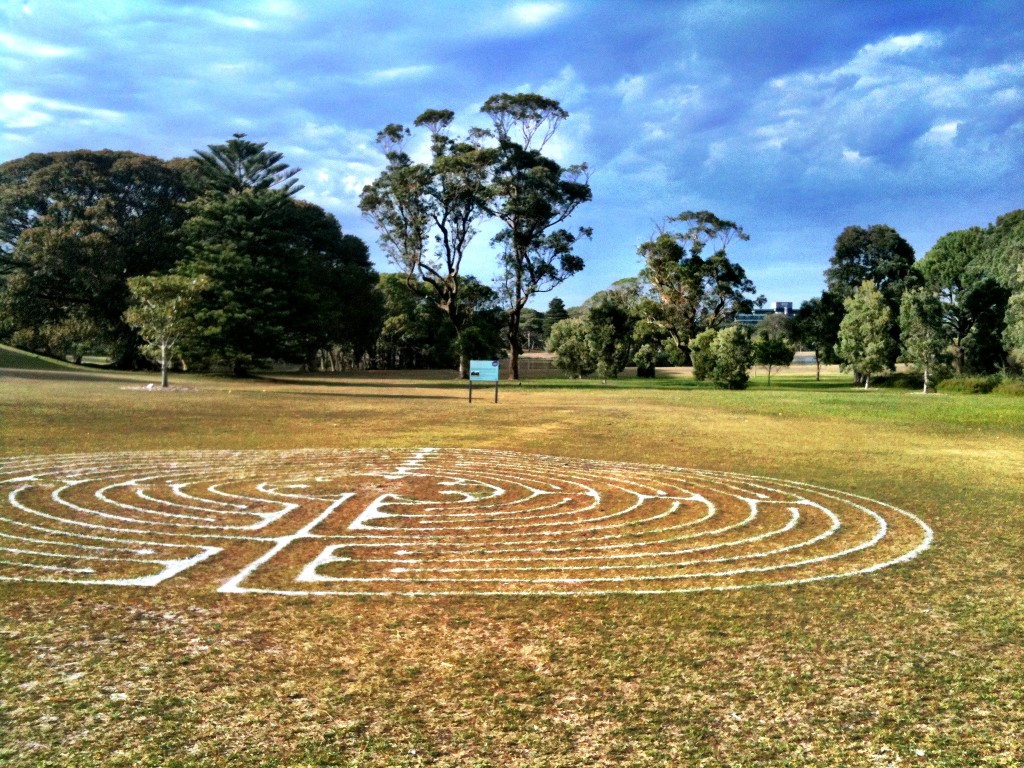
I can’t express how happy I am to know that Sydney will finally have its own public labyrinth… Information about it is here. It is currently drawn on the grass in a beautiful corner of Centennial Park, but over 80% of the funds needed have been raised to build the labyrinth in stone.

Every time I’ve done it so far I’ve been alone (except when I’ve brought people to show them) and it really is in a beautiful setting. Here, see for yourself!

IMG_1398

A labyrinth is a tool for contemplation and meditation. It’s not a maze as there is only one path to follow in, and one to get out! When I first discovered it, at St. Paul’s Church in Vancouver where it is drawn onto the floor of a gymnasium/dance place/event hall, I was struggling with sitting meditations. Walking meditation allowed me more easily to get out of my head and to find a tool that would guide me to do so was a great gift. I did the labyrinth on numerous trips home to Vancouver, and it allowed me peace, insight, space and solace, particularly when my father died.

Since I discovered the one in Vancouver, I’ve also walked the one in the Grace Cathedral in San Francisco, and then with great joy, on my birthday, the original in Chartres Cathedral in Chartres, France, where they only clear the chairs from over top of it on particular Fridays. While there are other labyrinth designs, the Chartres one is the one I love the best. It is complex with 34 turns and an amazing symmetry and design.

I always daydreamed of how to get one in Sydney. I’d contacted someone here many years ago who had a portable one; I kept my eyes open for news, but I never considered how I might set the creation of it in motion myself. Then out of the blue, I find that Emily Simpson was inspired in 2010 to facilitate its creation. She had the right idea and knew how to follow it up, and I suspect some pretty good organisational skills and contacts for the project to be moving along so successfully. I can’t be more grateful.

I’ll likely post more on the labyrinth in the future… but if anyone is in Sydney and would like to walk it with me, drop me a line!

IMG_1399

Posted in Spirituality, Sydney | Leave a comment

Book Review: Jonathan Franzen’s Strong Motion

Strong MotionStrong Motion by Jonathan Franzen

My rating: 4 of 5 stars

In Jonathan Franzen’s 1992 novel, ‘Strong Motion’, we see the prodigious talent that would bring him worldwide fame with ‘The Corrections’ and the more recent ‘Freedom’.

I enjoy reading earlier novels of authors who I’ve discovered when they’re more famous: you see where they’ve come from, what techniques they use that will be repeated, and how something that is good or even great becomes extraordinary.

In ‘Strong Motion’, Franzen displays his formidable intellect and how he uses it to explore, in depth, and with impressive displays of detailed knowledge, issues related to the global economy and the environment. For example, the premise of the book, a man-made cause to earthquakes is an interesting precursor to the environmental issues that he tackles in ‘Freedom’.

Franzen also shows how he grabs a theme and runs with it for the whole book, the idea of ‘freedom’, the idea of children correcting their parents’ faults, and here, possibly a less defined theme of how ‘strong motion’ whether in history, or in personal relationships, or geology, plays out.

Franzen’s amazing descriptions, wit, observations on familial dysfunction, his laments of alienation in a commodified world, and his leaps between his characters’ points of view are all here. He ties this all in with an engaging narrative, a bit of a detective-style thriller for modern America.

I would hazard a guess at some of the reasons why this book didn’t bring him the fame of ‘The Corrections’. Even though the main character is a young man in his early twenties and bald, I couldn’t help but picture all those author photos I’ve seen of Franzen and imagine him as described in the book (by a raccoon describing himself!) as ‘an individual living in a world that consisted entirely of his sorrow-like compulsions and afflictions and the pleasurable exercise of his abilities.’

The majority of the book is told from Louis’ point of view, and he’s a pretty drab character, sad and not particularly self-aware: he is full of sorrow. He rails often against consumer greed and sabotages himself and relationships. I found it hard to have sympathy for the main relationship in the book when the two characters seemed to have such strange, short interactions, a relationship driven by instinct and need rather than any sort of communication. I found Renée, the secondary character (or perhaps meant as the other main character, but certainly with less focus than Louis), as interesting but detached, cerebral, and somewhat cold.

It feels to me that in Franzen’s most recent novels, by spreading the rich narrative between many characters, he gives us more to hang onto, more to relate to, even if it is to the various neuroses of the characters rather than their virtues. As a writer, he really managed to develop his great strength of creating funny, difficult and complex characters, both men and women, and of different ages. In this book, I think he’s in the category of a great writer, rather than his later crowning as a ‘great American novelist’.

Franzen’s amazing ability to capture both the important and mundane parts of life are wondrous. A mother is described as such: ‘Of her relative proximity to death, or her inability to relax and enjoy a lunch, of her estrangement from the world of things that young people talk about. This really does happen to parents who are unhappy, even those who truly love their children.’

He often seems to describe, perfectly, some great truth about Western life. But also a small observation such as ‘ red pillow marks on his face—sleep’s tantalizing glyphs, which every morning signified nothing in a different way.’ The book is filled with amazing writing that I gasped at, each piling up one on top of the other in response.

I wasn’t quite as taken with his narrative experimentation as in his later books. Occupying the narrative point of view of a raccoon didn’t quite do it for me, neither did falling into Olde English for a historical account of the Indians, before colonisation, though it only lasted a few pages. As a minor complaint, I hate how the Chinese character in the book and his relatives speak in Chinglish, ‘He not here’. Howard’s lack of proficiency is described as a deliberate character trait but he displays no great gifts of character that make him likeable, not that he needed to be, but I personally recoil at an unpleasant Asian who speaks English poorly.

Right to the end, though I’d enjoyed the writing and the story, albeit not as much as ‘Freedom’ and ‘The Corrections’, I was still feeling uncomfortable and frustrated about the narrator and the book’s main relationship, a lack of resolve, an unpleasant heaviness.

But then suddenly, Franzen seemed to sniper-fire my complaints away and the characters show self-awareness and some measure of hope, and an important part of the sorrow and the weight of negativity somehow gives way.

Considering Franzen’s winding and lengthy narrative technique, I think that a similarly meandering book review is appropriate. I also feel that Franzen’s narrative rails against making simple conclusions or exhortations such as: ‘if you’re a fan of Franzen’s other books, you’ll like this’, ‘Great book, read it!’ or ‘See how Franzen became famous through one of his earlier books’.

So I won’t.

[P.S. Amazing interview with Franzen in the Paris Review… I read it after I wrote this review. http://www.theparisreview.org/intervi…]

View all my reviews

Posted in Book, Book Review, Review | Leave a comment

Guest Poet: Josh Stenberg

Josh Stenberg is an Asia-based Canadian writer and translator. His writing has been published in the Asia Literary Review, Kartika Review, and Vancouver Review. He has also  translated two volumes of Chinese short fiction.

the swan

the swan is blackening on the spit.
in the ravening hollow, white tigers
are caught by the toe. we had used
to get together whenever i was in
town. the doctors have drilled into
me through the nose; at their usual
rate. i have made love again to a cipher.
we are establishing vectors of disease. people
are groping for the way out. there are
grounds for suspicion; we are grinding
ourselves into fine white meal. we are
received with open arms. we are guilty by
association. the primary purpose
of language is to communicate. sure,
we are occlusions of meaning. the
masters are busy at the smith. smudges
of blood on the sharp ebony teeth of
my comb.

fujian lychees

the fruit leaves the branch,
oversweetens, is rushed precipitately
from the maritime border to the
centre, to the capital. there it is
ingested, assimilated, its reproduction
spat out. the pericarp sugars the
bloodstream. the warm current washes
out into the ocean. on its wild dissolving
route, the self is absolved. everyone
else does it. people may have to drown
for this alaska crab, this pinch of
saffron, this ten-thousand-li delight
for the palate. all distances are
immoral. food is the densest luxury.
the elderly are crushed by the
ravaging bewildered wagonwheel.
the lines of oil vein and thread us.
the concubine, twelve hundred years
dead, smiles. who is this portly
skeleton? why does she grin?
her yellow teeth skin the flesh off
the hard brown pit.

march 2002, montreal

those things too are becoming long ago.
winter was new to you then. we built
a man of shabby snow. the city to me was
pages in a book, signs of false remembrance.
took you down to watch the frozen saint
and think of the spring crawling north,
icebergs mooning down.

all the people we knew there have left.
and we have left. and what is left?
there are no seasons here, over here.
my students say, what is this tongue,
the same word to remain or to go,
for staying and passing, out, away?
                              but i say:
who cannot remember is never bereft.

Posted in Poetry | Tagged | Leave a comment

Concert Review – Radiohead, 12 Nov 12, Sydney

It’ll likely be sacrilegious for a Radiohead fan, but what I want to talk about in this review is the set. It was the most amazing set I’ve ever seen for a concert (and both Lady Gaga and Prince pulled out the stops for their concerts this year). Before the concert started, it looked like there might not be anything at all on stage. You could see some instruments lying around, but that was about it. Would it really be just them playing on a stage?

But no, as soon as it started, I recognised the set from a concert video that’s been circulating on youtube, that D sent me before the concert. They stand in front of a soaring wall of lights, the bottom third with a jewelled grid effect, and above that, a different sort of vertical lighting that went up to the ceiling. In front, at the top were 6 square panels, which started with square two-dimensional barcodes, a reference either to scanning in or consumerism. And suspended above Radiohead were 12 TV panels, very high definition that were raised and lowered into different configurations, sometimes flat, and othertimes at angles.

The effect of these panels was incredible and though it was a simple technique: that the panels often had a close-up of Thom Yorke signing, or the drummer’s hands, or a guitarist, but it felt the most original way of bringing the audience into the music. It wasn’t a simple set of televised images, so that those in seats further away could see what was happening. We were brought multiple aspects of what was happening on stage, breathing and pumping, alternating with images and colours.

And then the light show. I kept on thinking while watching: how to describe this? Would I be able to afterwards? Perhaps not, but I can try. The particular colour combinations used during various songs, pulsing and flashing and changing, were like crazy memories from all parts of your life, your dreams, nightmares and sub-conscious. The colour of volcanic explosions, or deep oceans. Hot bright pinks. The flash of old cameras. Everything in sepia tones. This one with the references of the covers and colours of old jazz albums. It felt like dozens of cultural references at once, but taken out of context, and swept into the music, hard for me to identify any of what was happening.

Of course, the other sacrilege is that I don’t know Radiohead’s music very well. So, the next most interesting thing to me after the amazing set was to experience the cultural phenomenon of Radiohead. The music is not pop or conventional, the rhythms shift and change quickly, so the usual collective sway and motion of an audience was absent here. Everyone was moving to Radiohead in their own way (or not moving at all): all rapt in attention but in a weird collective and individual experience of the music. Nearer to the end of the nearly 2.5 hr set, there were a few more songs with recognisable lyrics and melodies, a song structure, but much of it felt like this enormous wave of dark emotion and energy that hit mainly at an unconscious level. And how could it not sweep by the brain when the vibrations of the low bass were making all the organs in my body pulse at the same time as what was happening on stage?

An amazing experience.

Posted in Concert | Leave a comment

Kamahl Extras!

Kamahl Interview, Part 2: Extras!

When I arrived at Kamahl’s beautiful and spacious home in quiet North Sydney, he asked me to sit down at his table, and apologized if there were any problems with our interview time. He had to go to an event that afternoon for the Screenwriter’s Guild. “I don’t know why they want me there, I’m not a composer for films,” he said offhandedly.  “Decomposing perhaps, but…”

Here’s more of Kamahl’s wit and self-deprecating grace:

On fans

I’ve always had the highest regard for my audience. I’ve never short-changed or deceived them and had the utmost respect for them and it’s been returned not two-fold but ten-fold…

Kamahl often receives fan letters or requests from people who tell him how important his songs have been to their families or lives:

When all is said and done, that is what you hope for but you never think you’ll get, like being part of somebody’s family for their engagement, their wedding, their funeral, to be that way involved, from the humble beginning, is an interesting journey, sometimes I think it’s much too much, sometimes when you get letters like that, you think it’s worth the slings and arrows of outrageous fortune.

On being a tall poppy

The “Elephant Song” became the number one song in Holland, Belgium, Norway, Sweden, Denmark, Finland… sometimes when you have that kind of success, that irritates the locals, because they haven’t had it. “Why him?” they go. It’s less so now, and with the rock and rollers it’s fine, but it could have been an element of tall poppy syndrome…It’s difficult because in America they respect the people who’ve stood the distance. Here there is scant regard for that sort of thing.

On his friendship with Donald Bradman

One of the unexpected events in my life was meeting Sir Donald Bradman and enjoying his friendship for the last 13 years of his life. It was the closest thing to meeting God.

On meeting Rupert Murdoch who eventually became his sponsor for citizenship.

That was an absolute fluke, he was in a restaurant with his first wife, and I happened to be the singer for the night, singing for my sandwiches, not even paid. That same evening, when it was over, somebody invited me to go with them to another party that later turned out to be the News Limited Christmas party of 1958, and it was because the people reacted so generously and warmly and not Rupert’s musical taste that he was moved to rush to me literally and hand me a ten pound note. I haven’t reminded him of that… I didn’t want to embarrass him.

On reality TV stars

The guy who sang Nessum Dorma on English Idol [Paul Potts], he had 58 million hits [on youtube], Pavarotti had 12 million, and [there are other older singers] who sing better, and died a long time ago… Paul is a turkey compared to the others! 58 million hits to listen to a turkey. That’s the sad part. It’s good that that many people were exposed to a better kind of music… but these kinds of things bother me a lot.

A favourite author?

Vikram Seth. I found his writing quite brilliant. I went to a book launch of his. He was a lot smaller than I thought he would be. It was funny, when he stood up he was shorter than when he was sitting because they had a funny high chair. This is the perception. You think great minds come in larger parcels!

Currently reading?

A “magnificent” book about Charles Darwin.

Current projects?

Kamahl is involved with many charities including the newly revived World Wildlife Fund, the Ronald McDonald House, The Red Cross and The Bradman Foundation.

His last recording was “I was a mate of Don Bradman” which he was disappointed didn’t get more attention. Kamahl is also looking at selling his back catalogue of songs (500–600) as a way of keeping his legacy alive.

What advice do you have for some of our young Asian-Australian writers and artists as they are starting their careers?

I don’t think there is any substitute for knowledge, to know as much about your craft. I say this because I never had the chance to do that. And get the best coach, it’s cheaper in the long run. I don’t think talent alone is enough… Talent is one thing but [you need] determination. Perseverance. There is this element of luck, to be at the right time and right place. Be forever ready when the moment comes to grab it. Very seldom do you get a second chance. Because it is a jungle. You got to have a fire in your belly… Find that one person in your life who believes in you, as much as you believe in yourself, or even more, especially if you can find that person in a company to help you and guide you. I found one or two of those people along the way.

For more on Kamahl, visit his official website, or check out this interview on ABC’s Talking Heads that tells of his early days in Australia as well as how Rupert Murdoch came to be his sponsor.


Posted in Stuff | Leave a comment